One question, a whole outfit. Your catalog was built for the wrong unit.
Shoppers are asking AI for complete answers, not single products. When the unit of recommendation becomes the outfit or the routine, a catalog of well-described items is not enough. It needs a model of the person the pieces are for.
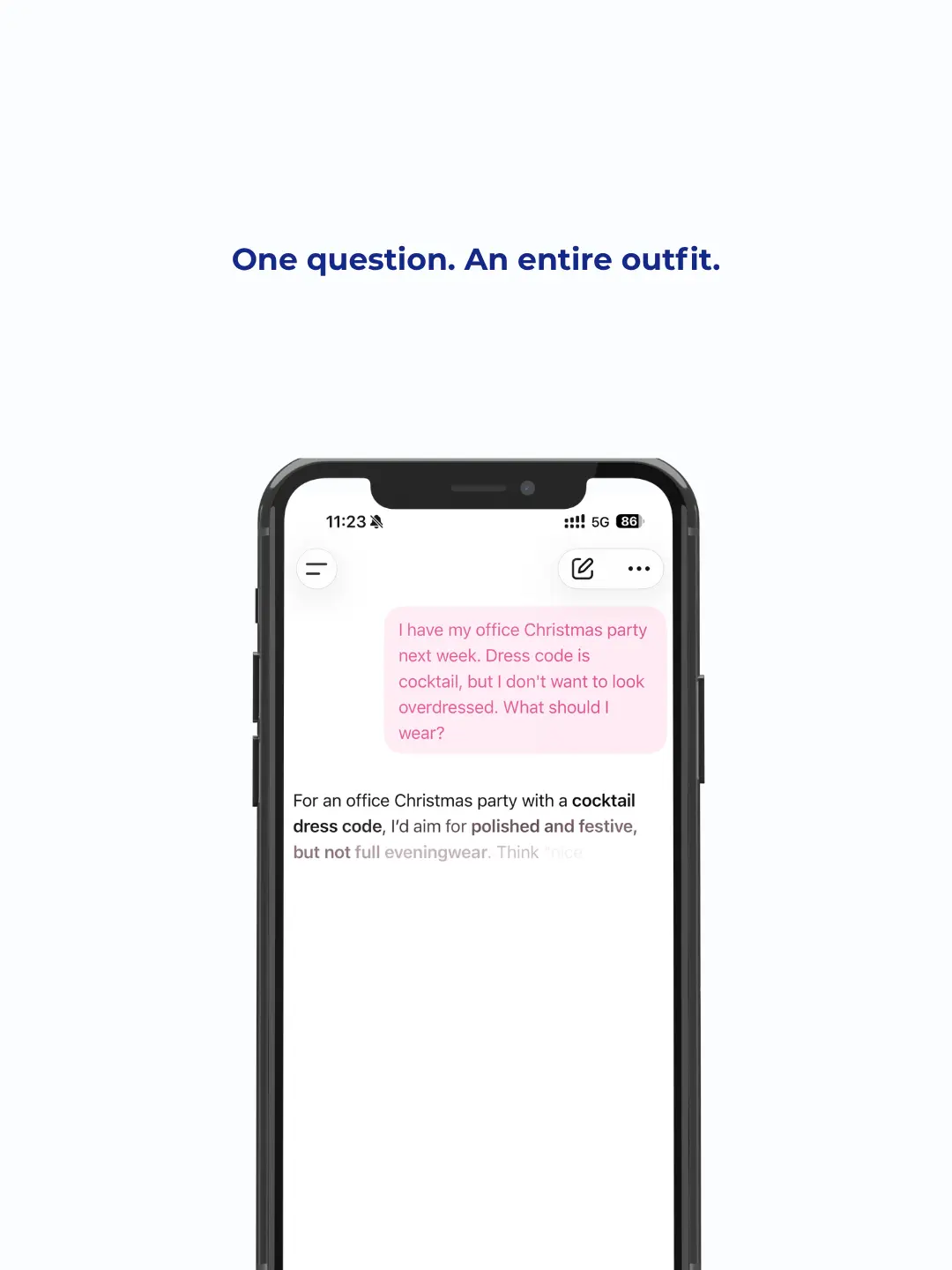
Here’s a prompt a shopper typed into ChatGPT: “I have an event next week. Dress code is cocktail, but I don’t want to look overdressed. What should I wear?”
The answer she got was not a product. It was a point of view: polished but not full eveningwear, a dress with some restraint, shoes that dress it down a notch, one piece of jewelry instead of three. A whole outfit, from one question.
Now ask yourself which of your products that answer was built from. Not which one it named. Which one it was built from. That gap is the subject of this post.
The unit of recommendation just changed
Your catalog is organized around items. One SKU, one page, one set of attributes. Search, filters, and recommendation widgets all inherit that shape. Even “complete the look” modules are mostly item-to-item lookups: people who bought this also bought that.
A shopper talking to an AI assistant doesn’t think in items. She thinks in outcomes. An outfit that works for an event. A routine that works for her skin. A bag that works for a week of travel. The assistant answers in the same unit, and then, if it has a path to your products, it has to fill each slot of its answer with something real.
That second step is where most brands disappear.
What it takes to fill the slots
To assemble an outfit, an agent has to answer questions that no single product page asks:
- Does this dress sit at the right level of formality for “cocktail, but not overdressed”?
- Do these shoes soften it or compete with it?
- Is the color flattering on someone with her coloring, or just on the model in the photo?
- Will the pieces work together, or only each on its own?
Every one of those is a relationship: dress to occasion, shoe to dress, color to person. A typical product page states facts about one item instead: fabric, length, sizes, price.
This is the same point we keep coming back to. Product data answers the product half of the query. The shopper’s question has a person half too, and an outfit question has two more halves stacked on top: how the pieces relate to each other and how the whole thing relates to the event.
Why this is harder than it sounds
When an agent recommends one product, a missing attribute costs you a match. When it assembles a set, missing attributes compound.
If it can’t tell how formal your dress is, it skips the dress. If it can’t tell what your shoes pair with, it picks a competitor’s. If your color data says “navy” and nothing about undertone, it can’t tell whether navy works for her. Each gap is a place where another brand’s more legible product takes the slot, and an outfit has five or six slots.
Fashion and beauty feel this first
This isn’t unique to clothes. A skincare routine is an outfit for your face: cleanser, treatment, moisturizer, sunscreen, each of which has to work with the others and with the person’s skin.
These are the categories where matching is hardest, because the attributes that decide the answer are relational. They live between the product and the person, and between one product and the next. A spec sheet can’t hold them. That is also why returns are so high in these categories. The shopper bought the item. The outfit never came together.
What changes for a brand
You don’t need to rebuild your site. You need to ask your product data to carry more than its own facts.
Start with a small set, your ten most-viewed pieces, and ask what an agent would need to know to place each one inside someone else’s answer:
- What occasions and dress codes does it suit, and how formal is it on a real scale?
- What does it pair with, and what does it deliberately not pair with?
- Whose coloring, proportions, and style does it work for, and why?
- What role does it play in an outfit: anchor, layer, finishing piece?
Then run the test the way a shopper would. Write five outfit questions with different occasions and constraints, and see what an AI assistant assembles. If your pieces don’t show up, or show up with reasons that have nothing to do with the person or the event, you are indexed but not chosen.
This is the work the Product-Customer Intelligence Layer does. It reads the traits a photo contains and a feed doesn’t, structures who and what each piece is for, and holds it in a form an agent can reason over. The outfit is just the clearest test of whether that layer exists.
Where to start
The question your customers are asking is already bigger than a product. The brands that get picked will be the ones whose catalogs can answer at that size.
A free AI visibility audit shows how an assistant treats your pieces when the question is an outfit, not an item. Or book a demo and we’ll walk through your catalog together.