Fashion and beauty are the hardest problems in AI commerce. That's exactly why we're building there.
Electronics has specs. Fashion has fit, drape, and body shape. Beauty has undertone, skin type, and finish. Generic recommenders fail here in ways that show up as returns, and a shopper model that works here will work anywhere.
If you wanted to pick the easiest category to build an AI shopping agent for, you would not pick fashion or beauty. You’d pick laptops. A laptop has 16 gigabytes of memory or it doesn’t. It has a 14 inch screen or a 16 inch screen. The shopper’s question maps to a spec, the spec is in the feed, and the match is a lookup.
We picked fashion and beauty on purpose. Not because it’s where the easy wins are, but because it’s where the hard problem lives, and the hard problem is the one worth owning.
There is no spec for “flattering”
Consider what a shopper actually asks. “Something flattering for a pear shape at a fall wedding.” “A foundation that won’t oxidize on my warm undertone.” “A blazer that works for my long torso and doesn’t look boxy.”
None of those map to a field. Whether a dress is flattering on a pear shape depends on the body shape and the garment’s cut, together, in a way neither describes alone. Whether a foundation oxidizes depends on the formula, the skin’s chemistry, and the finish. Whether a blazer looks boxy depends on shoulder construction, length, the person’s proportions, and what she’s wearing it over.
These are relational properties. They exist between a person and a product, not in either one. That is the whole difficulty, and it is why the category has resisted every generic recommender that’s been bolted onto it.
The failure shows up as returns
Online apparel is returned at rates no other category tolerates, and the standard explanations are fit and expectation: it didn’t fit, or it didn’t look the way she imagined. Both are discovery failures. The product was matched to her on attributes that didn’t predict whether it would work, because the attributes that would have predicted it were never captured.
Beauty has the same pattern with a different face. A shade that looked right in a swatch and wrong on skin. A formula that was “for all skin types” and slid off by noon. The product wasn’t bad. The match was.
A recommender that ranks by popularity, co-purchase, or keyword similarity cannot fix this, because none of those signals carry the relational information. Showing someone the dress most people bought tells her nothing about whether it works on her.
What it takes to actually match
Solving the match means building two things that most commerce stacks have never had.
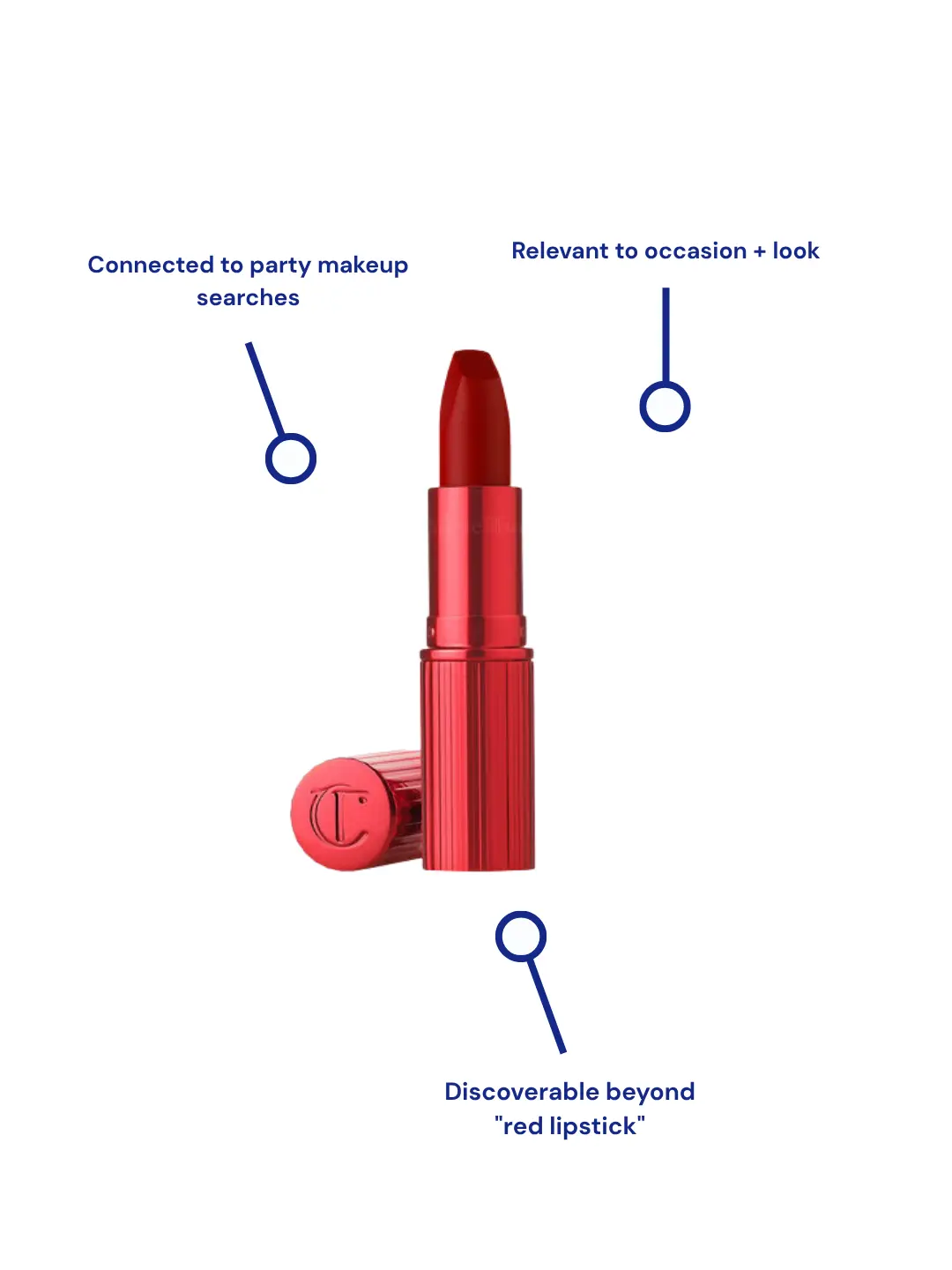
First, product understanding at the level of the physical object. Not the description, the thing. Silhouette, drape, cut, rise, neckline depth, sleeve construction. For beauty: pigment undertone, finish, texture, opacity. This comes from computer vision applied to the product imagery, extracting the 200 plus traits a photo contains and a feed does not.
Second, a model of the person. Body shape, proportions, skin tone and undertone, style sensibility, the occasion and climate she’s shopping for, what she’s bought and returned. Structured, specific to her, and held in a form that can be matched against the product traits.
Then the matching itself: color theory, fit logic, occasion rules. The functions that turn “pear shape, fall wedding, warm undertone” into a ranked shortlist with reasons. This is what we mean when we say Product-Customer Intelligence Layer. It’s the three pieces together, built for the category where all three are hardest.
The hard category is the general solution
Here is the strategic point. A system that can match a person to a foundation, where the relevant attributes are subtle, visual, and relational, can match a person to almost anything. The inverse is not true. A recommender tuned on laptops has never had to learn what “flattering” means, and it can’t be taught in a quarter.
So fashion and beauty aren’t a niche we happen to serve. They’re the proving ground. The shopper model gets built here because here is where it has to be good, and once it’s good here, the rest of commerce is a smaller problem.
As AI agents take over more of the shopping decision, the categories where the decision is hardest are the ones where a real matching capability is worth the most. That is the bet.
See it on your own products
If your catalog is in fashion or beauty, the test is simple. Ask an AI assistant a relational question about your best seller: not “what is it” but “would it work for someone like this.” A free AI visibility audit runs that test across your products and shows where the match holds and where it falls apart. Or book a demo and we’ll show you what the layer sees in your catalog.