Every gift question has two customers in it. Your catalog knows neither.
A gift query describes a recipient, a budget, and a relationship, and the person asking is a third fact. Here's why the model of the customer has to hold the buyer and the person being bought for, and what that asks of your catalog.
Here’s a question a shopper might type into ChatGPT this week:
“I need a gift for my 25-year-old sister. She loves makeup but she’s hard to buy for. I can spend about $60.”
Count the people in that sentence. There are two. The one typing, and the one who will open the box. Most catalogs are built as if there were only one.
The buyer and the recipient want different things
The person asking has a budget, a deadline, and a fear of getting it wrong. She wants something that looks considered, arrives on time, and doesn’t need a returns conversation at a family dinner.
The person receiving it has a skin tone, a finish she likes, and a drawer full of products she already owns. She is also, by the buyer’s own admission, hard to buy for. That phrase is doing a lot of work. It means the obvious picks are probably taken.
Neither of them is on your product page. The page describes a palette: twelve shades, shimmer and matte, vegan formula. That is true, and it answers neither of them.
An agent has to hold both at once
When a person shops this way, she carries both profiles in her head and does the matching quietly. An agent can’t. It has to take that one sentence and work out three things.
Who is asking. Budget of $60, wants low risk, probably wants it to feel like a gift and not like a restock.
Who it’s for. A 25-year-old who owns plenty of makeup. A single foundation or one lipstick shade is a gamble, because it only works if you know her coloring. A set with a range of shades, or a product that doesn’t depend on undertone, is safer.
What the product is. Is it giftable? Does it arrive ready to give? Does it work across skin tones, or does it need the recipient to be a particular person?
The third question is the only one your catalog usually answers, and only partly. The first two are about people. That’s the person half of the query, and it’s where the decision gets made.
Giftability is a trait, and so is risk
Brands tend to treat “gift” as a collection. A landing page, a banner, a tab in the nav. That’s merchandising, and it matters for humans who browse.
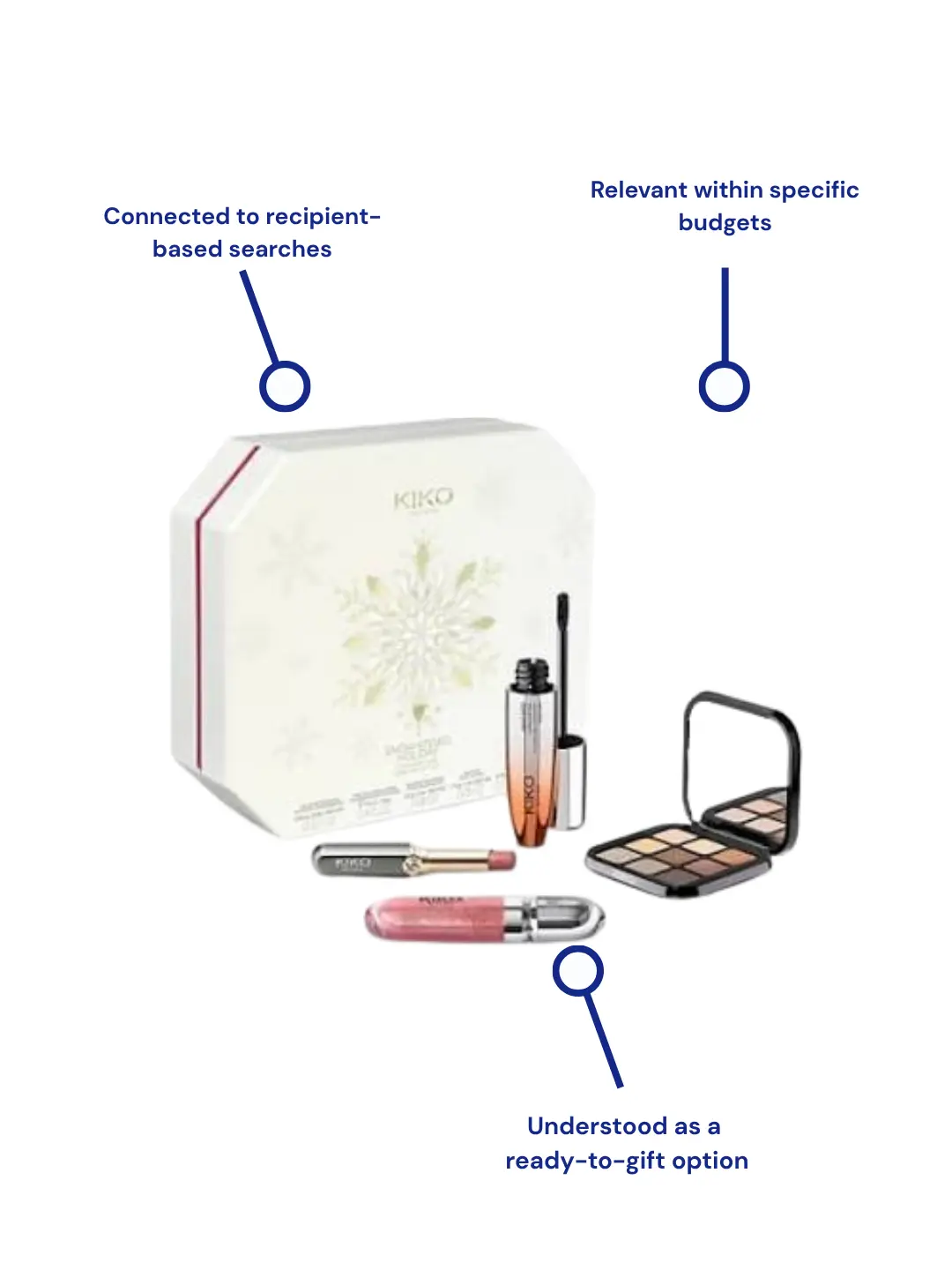
An agent needs it as data attached to each product. Is it presented as a set? Does it ship in packaging that works as a present? And the one almost nobody records: how forgiving is it for someone who doesn’t know the recipient’s exact coloring or size?
A palette of warm neutrals is forgiving across a lot of faces. A single bold lip color is not. A bracelet with an adjustable clasp is forgiving. A ring is not, unless you know the size. These are the facts a careful friend uses when she says “get her the set, not the single one.” They live in the product, and almost no feed writes them down.
This is what computer vision over the product can read: the number of items, the range of the shades, the finish, the packaging. The other half, how a given recipient’s coloring and taste meet those facts, comes from the model of the customer. You need both, and they have to be able to talk to each other.
Where this shows up first
Fashion and beauty are the first categories where this gets expensive, because the stakes of a wrong guess are higher. A mismatched gift gets returned or, worse, sits unused. That’s why the relational attributes (undertone, fit, finish, risk) matter more here than in categories where a spec sheet settles the question.
It’s also why gifting is the clearest view of something broader. Every query is a little bit like this one. Even when a shopper is buying for herself, she is describing a person: her coloring, her routine, the event on her calendar. Gifting just makes it obvious by splitting the person in two.
What to do about it
Start small. Take your ten best-selling gift sets and ask what an agent would need to know to recommend each one to a nervous buyer.
- Is the set described by who it suits, not just what’s in it?
- Is it clear whether it works across skin tones and tastes, or only for a specific person?
- Does the data say it arrives gift-ready?
- Does it hold up across a few price points, so a $60 query has a real answer?
Then run the test. Write five gift questions in the voice of a stressed buyer, each with a different recipient and budget, and ask an AI assistant. If your sets never come up, or come up with reasons that have nothing to do with the recipient, your catalog is answering a question nobody asked.
A free AI visibility audit runs this kind of test across your catalog and shows where buyer and recipient questions go unanswered. Or book a demo and we’ll run your gift sets through it live.