Occasion is the most overloaded tag in your catalog. It's also not about the product.
Brands tag products with occasions and call it done. But an occasion is really a set of facts about a person, and a label on the product can't carry them. Here's what the model of the customer does with it.
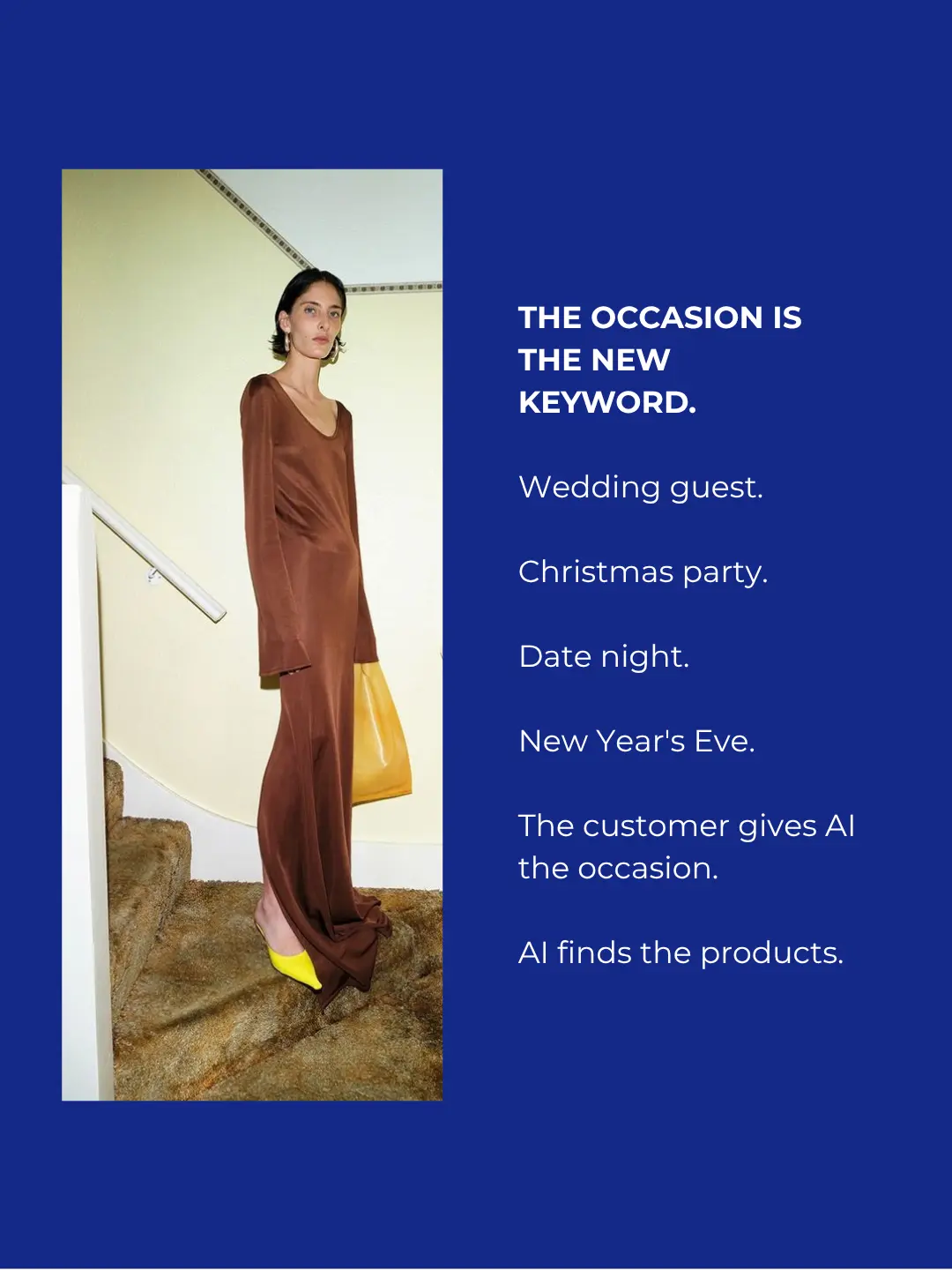
Open almost any fashion catalog and you’ll find a tag called “occasion.” Party. Work. Vacation. Wedding guest. Someone on the merchandising team filled it in, probably in bulk, and everyone agreed it was done.
I think this is the most overloaded field in the whole feed. It looks like a product attribute. It isn’t one.
A tag says what the dress is called. The occasion says who is wearing it.
Take a shopper’s real question:
“I’m the sister of the bride at a rehearsal dinner in Nashville in October. I’m 5’2” and I don’t want to upstage anyone. Something I can sit and eat in for three hours."
Pull that apart and see how much of it describes the person and the context rather than the garment.
About her: 5’2", wants to stay understated, sits through a long dinner, family role at the event.
About the setting: rehearsal dinner (semi-formal, evening), Nashville, October (mild, but it can swing).
About the product: a dress, probably. That’s the only product fact in the whole sentence, and it’s implied.
Now look at your tag. “Occasion: Wedding Guest.” It matches this woman and also a 5’10" guest at a beach ceremony in July who wants to be photographed. Same tag, two completely different right answers. The tag can’t tell them apart, because the difference between them lives in the shopper, not in the satin.
Why this matters more as agents take over
When a person browses, they close the gap themselves. They scroll, squint at the photos, read the reviews, and decide that “wedding guest” doesn’t mean “this one” for her. The product page can be sloppy because she does the matching in her head.
An agent can’t do that. It takes her sentence, splits it into facts about her and facts about the setting, and goes looking for products that answer each one. Where it finds a vague label, it has nothing to compare against. So it falls back on whatever it can read elsewhere: a blog’s roundup, a retailer’s description, reviews that happen to mention a wedding.
Your product wasn’t judged unsuitable. It simply never got to answer. That’s the difference between being indexed and being chosen, and occasion is where most fashion brands feel it first.
What an occasion actually decomposes into
When we model an occasion at Veristyle, we don’t treat it as one value. We treat it as a bundle of things that each need their own answer:
- Formality. Where does this sit between “nice dinner” and “black tie,” and how much room does it leave to dress it up or down?
- Setting and climate. Indoors or out, evening or daytime, and what the weather in that place and month does to fabric and layers.
- Comfort over time. Can she sit, eat, dance, and carry a bag in it for four hours?
- Visibility. Is this the night to stand out, or the night to blend in?
- The person. Her height, proportions, coloring, and what she already feels good in.
The first four can be read off the product with computer vision: the drape, the neckline, the weight of the fabric, how structured the silhouette is. The last one comes from the shopper. The match happens when the two are laid side by side. Neither half works alone, which is the point I keep making about the product half and the person half of the query.
So what should a brand do with the tag?
Keep it. It’s useful. Just stop expecting it to carry the load.
Treat the occasion tag as the front door, and build the rooms behind it. For each product, that means recording how formal it really is, what settings and climates it suits, how it behaves over a long evening, and which body types and colorings it flatters. Those are the facts an agent can actually line up against a sentence like the one above.
Some of this you can write by hand for your top sellers. Across a few thousand SKUs, you need it extracted from the product itself, consistently, in a structure a model can reason over. That’s the layer we build.
A test worth running this week
Pick one of your dresses tagged for weddings. Write three shoppers who would each want it, and three who shouldn’t: different heights, different seasons, different settings. Now ask an AI assistant each of the six questions.
If it recommends your dress to all six, or to none of them with any specific reason, your catalog is telling it the tag and nothing else. A free AI visibility audit runs this kind of test across your catalog and shows where occasion questions go unanswered. Or book a demo and we’ll take your wedding edit through it live.