She has a wedding in three weeks. Is AI recommending your dress?
Wedding guest shopping is one of the highest-intent, most time-boxed purchases in fashion, and almost nobody is optimizing for it. Here's why that's a mistake and what to fix first.
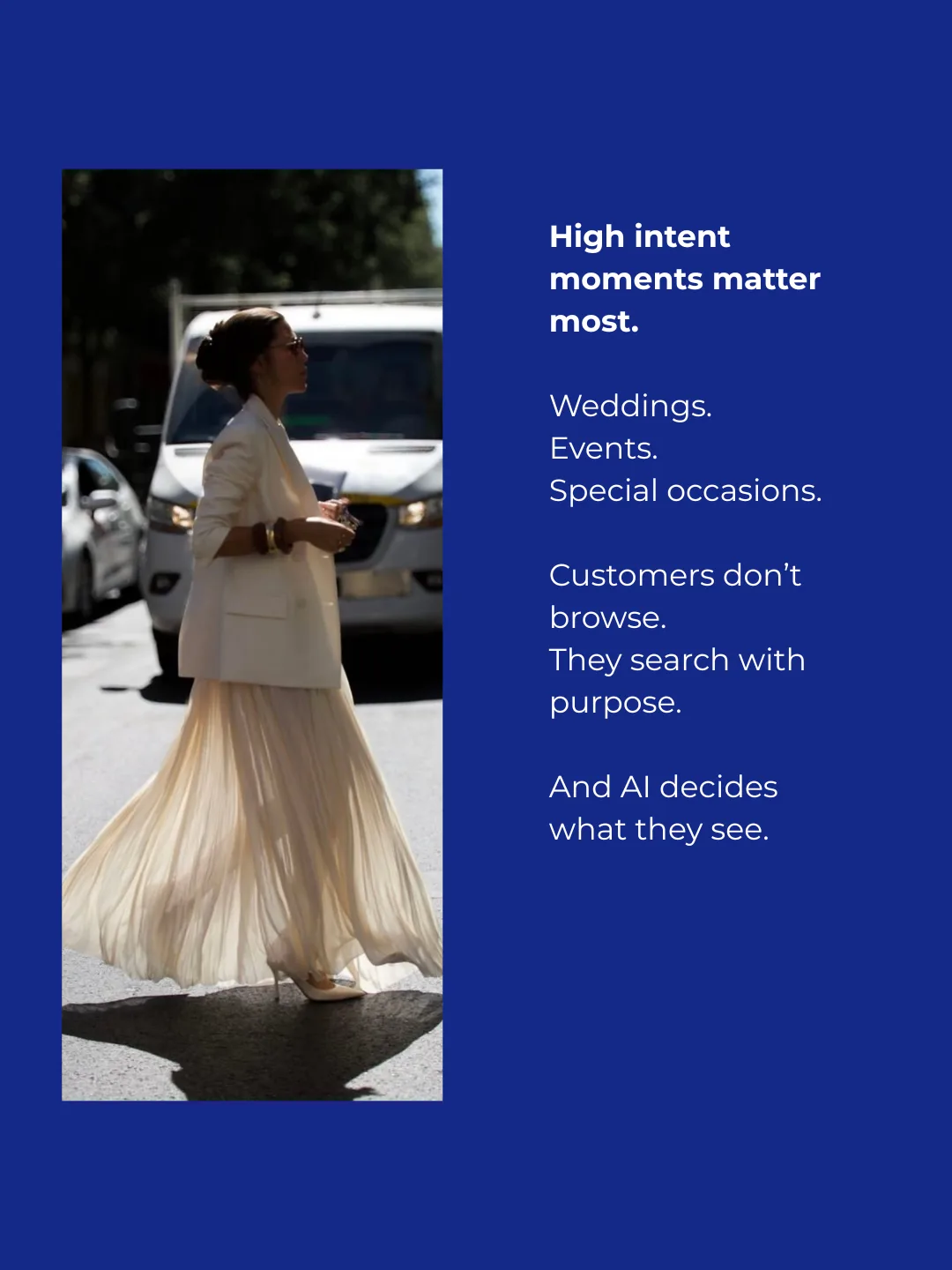
It’s peak wedding season, and somewhere right now a bridesmaid is typing a question into ChatGPT instead of scrolling a category page. Something like: “wedding guest dress, outdoor September wedding, not too formal, under $200, won’t look like everyone else’s Instagram.” That’s not a browse session. That’s a shopper with a date on the calendar and a decision to make before it arrives.
Most fashion brands still treat wedding guest shopping like generic occasionwear traffic. It isn’t. It’s one of the most specific, time-boxed, high-intent purchases a customer will make all year, and right now it’s happening largely outside the channels brands are set up to win. That’s exactly the gap AI search optimization for fashion brands closes.
A wedding guest search has rules a normal search doesn’t
Nobody shopping for a wedding is just looking for “a dress.” They’re solving a small set of constraints at once: the formality the invitation implies, the season and venue, a budget, and an unspoken rule almost every guest follows without saying it out loud, which is don’t outshine the bride and don’t underdress for the room.
An AI assistant trying to answer that question needs your product data to already contain the answer. “Floral midi dress, $128” tells it nothing about formality. “Semi-formal, garden-appropriate, breathable fabric for an outdoor September event, not white or ivory” gives it exactly what it needs to make the match with confidence, and confidence is what turns a recommendation into a click.
Why this window is worth fighting for
Occasion dressing already converts better than everyday basics because the shopper isn’t comparison shopping on price alone. She has somewhere to be. But that same urgency cuts both ways: if she can’t tell whether a dress is right for the event, she either abandons the search or buys two options and returns one, sometimes both. A rushed, uncertain purchase is exactly the kind that ends up back in a box a week later.
The brands that win this window aren’t necessarily the ones with the biggest occasionwear assortment. They’re the ones whose catalog can answer the specific question being asked, at the moment it’s asked, whether that’s inside a chat window, an AI Overview, or a personalized result on the brand’s own site.
What actually has to change in the product data
This isn’t about rewriting product titles to sound nicer. It’s about giving an AI assistant the same judgment a good stylist would apply in a fitting room:
- Formality level: black-tie, semi-formal, garden, beach, courthouse
- Season and setting: outdoor versus indoor, fabric weight, whether it photographs well outside
- Guest etiquette: color and shade restrictions, modesty for religious or family-specific events, whether it reads as “trying too hard”
- Fit and body type: petite, tall, plus, how it moves for a full day of standing and dancing
Veristyle’s Product-Customer Intelligence Layer reads every product with computer vision and tags this level of nuance automatically across a full catalog, then puts it to work in two places at once: fit-aware, occasion-aware recommendations on your own storefront, and the structured data that lets ChatGPT, Perplexity, and Google’s AI Overviews recommend your dress by name instead of skipping past it for a competitor whose catalog was easier to understand.
None of this requires touching your storefront design or replatforming. It layers on top of the catalog you already run.
The window is short, and it’s already open
Unlike a seasonal sale, wedding guest demand doesn’t wait for a marketing calendar. It shows up the day an invitation lands in someone’s inbox, and it resolves within a few weeks, sometimes days. By the time a brand notices the traffic pattern, the shopper has already bought from whoever’s catalog answered first.
If you want to know what AI assistants can currently tell about your occasionwear, an AI visibility audit takes about five minutes and shows you exactly where the gaps are.
Book a demo and let’s make sure the next wedding guest search ends with your dress in the answer.