The AI agent isn't asking what your product is. It's asking who it's for.
Most GEO work optimizes the product half of the sentence. In agentic commerce, the half that decides the sale is the shopper. Here's why a customer-centric intelligence layer is the part of AI readiness that doesn't commoditize.
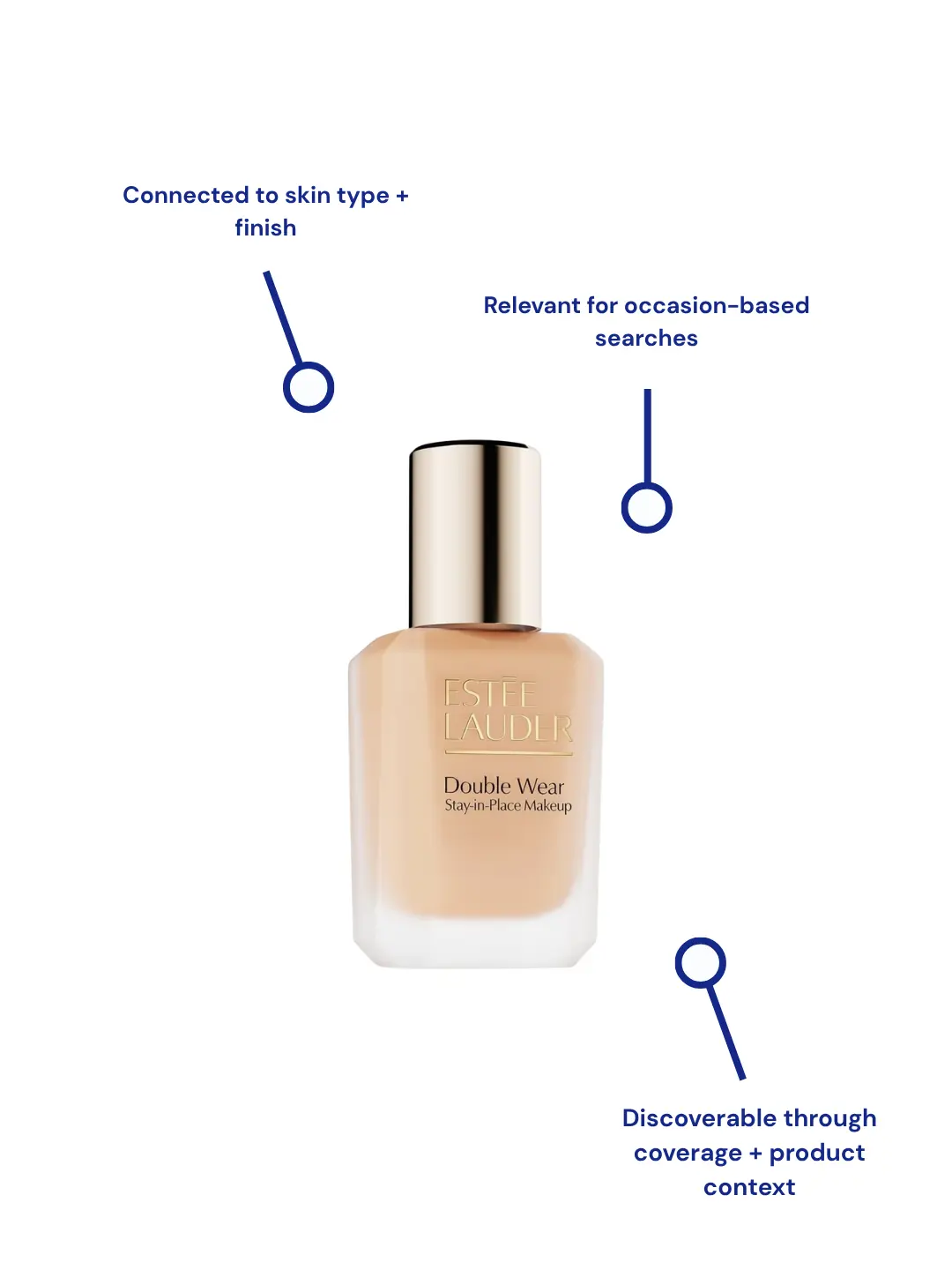
A shopper opens ChatGPT and types: “I have combination skin with a warm undertone. I need a foundation that will survive a 12 hour outdoor wedding in Austin in August. Medium coverage, natural finish, under $60.”
Read that again and notice what it’s made of. Six words about the product. Thirty about her.
That ratio is the whole story of AI shopping, and it’s the part of the story most AI search optimization skips.
The product half is getting solved. By everyone.
Over the last year, a category of GEO and AEO tools has grown up around a single idea: make product pages legible to language models. Cleaner descriptions, structured data, llms.txt files, richer attributes. It’s real work and it matters. We do it too.
But it’s work that every brand will eventually have done, because the inputs are the same for everyone. A description is a description. Schema is schema. When the whole category is optimized, the model has a hundred foundations that all say “24 hour wear, medium to full coverage, 50 shades,” and it still has to pick two.
What does it pick on? The other half of the sentence. The person.
The question an agent actually has to answer
A product-centric system answers “what is this.” A shopping agent has to answer “is this right for her,” which is a different computation with different inputs.
To answer our Austin shopper, the agent has to resolve at least six things: what “combination skin” means for formula choice, which of the 50 shades map to a warm undertone, whether “24 hour wear” holds up in 100 degree humidity, what “natural finish” rules out, whether “medium coverage” is a formula property or a technique, and whether the price lands under $60 at a retailer it can actually transact with.
Almost none of that is on the product page. Shade names don’t carry undertone. Formulas don’t declare which skin types they’re built for. Climate performance isn’t a field. The agent is being asked to match a person to a product using data that only ever described the product.
The gap isn’t missing adjectives. It’s a missing layer: the structured understanding of who a product is for, held in a form a model can reason over.
This is the layer Veristyle builds
We call it the Product-Customer Intelligence Layer, and the name is deliberate. It has two halves and a function between them.
The product half is computer vision run on your existing catalog imagery, extracting 200 plus physical and style traits: silhouette, drape, cut, finish, pigment depth, texture, the things that are visible in a photo but never typed into a feed.
The customer half is a model of the shopper: physical traits, skin tone and undertone, body shape, style sensibility, the occasion, the climate, the intent behind the question. Not a persona. A structured representation of a specific person, assembled from what she said and what she’s done.
Between them is matching: color theory, fit logic, and occasion rules that turn “warm undertone, combination skin, August wedding” into a ranked shortlist with reasons attached. That output is what gets written back to your catalog as machine-readable data, and it’s the same output that powers on-site discovery when she lands on your page.
That’s the difference from a product-centric tool. We don’t make the description better. We make the product answerable.
Why this becomes mandatory, not optional
Agentic commerce is early. Today the agent recommends and the shopper clicks. Within a few product cycles, the agent will compare, decide, and complete the purchase on the shopper’s behalf, with the brand’s site never loading in a browser.
When that happens, there is no page to persuade on. No hero image, no reviews widget, no exit-intent offer. The entire funnel collapses into one step: did the agent’s matching function select your product for this person, or didn’t it.
Every product sold through an agent will need a machine-readable answer to “who is this for,” at the level of detail the shopper used to describe herself. Brands that have only optimized the product half will be indexed. Brands with a customer-centric layer will be chosen. Indexed is table stakes. Chosen is revenue.
It pays off before the agents arrive
The reason to build this now isn’t only the future. The same layer that makes a product recommendable off-site makes it convert on-site today, because the shopper who arrives from an AI recommendation is already describing herself, and a page that answers her in those terms closes.
Brands running this on their existing Shopify and headless storefronts, without replatforming, have seen average order value run roughly double baseline and AI-referred organic traffic roughly triple within 30 to 60 days. One piece of infrastructure, paying out on both sides of the click.
Where to start
Ask an AI assistant your own category’s version of the Austin question, one that describes a person in detail and your product barely at all. If the answer names you, read why. If it doesn’t, read why it named someone else. Either way, the reasons it gives are a specification for the layer you’re missing.
A free AI visibility audit runs that check across your catalog. Or book a demo and we’ll show you what the layer sees in your products.