Your loafers aren't just office shoes. Does your product data know that?
One product can answer a dozen different AI searches, office dressing, capsule wardrobe, weekend travel, if the data behind it says so. Most catalogs only let it answer one.
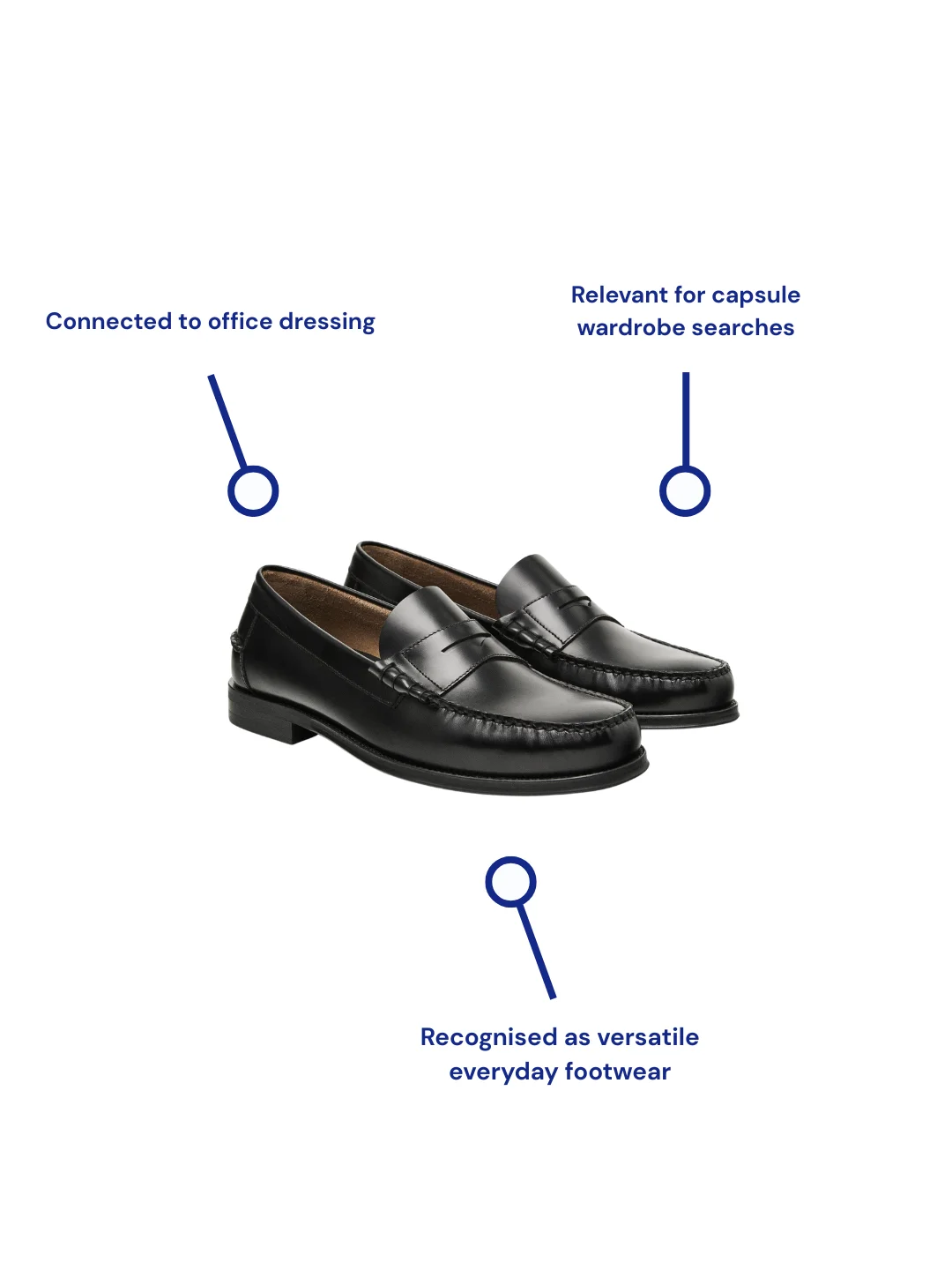
She wore the loafers to the office on Monday, to brunch on Saturday, and packed them for a long weekend in Lisbon two weeks after that. Same pair, three completely different reasons to reach for them. If you asked an AI assistant to help with any of those three moments, would it know to suggest yours?
That’s the part most catalogs get wrong. Not the product. The product is usually fine. It’s that the data behind it only tells one story, and the story it tells is almost always the narrowest one.
One SKU, a dozen questions
A shopper doesn’t ask an AI assistant “recommend me a black leather loafer.” She asks “what do I wear to the office that also works for a weekend trip,” or “I need one pair of shoes that can do everything for a capsule wardrobe,” or “something polished but comfortable enough to walk a city in all day.” Three different questions, and the same pair of loafers is a genuinely good answer to all of them.
The problem is that most product data was never built to answer three questions. It was built to answer one: what is this. Category, color, material, size. That’s enough for a shopper who already knows exactly what she wants and is just filtering a grid. It’s nowhere near enough for an assistant trying to figure out whether a product fits a situation it’s never been explicitly labeled for.
Versatility is the thing nobody writes down
Here’s the pattern we keep running into with clients. The product itself is genuinely multi-purpose, comfortable enough for travel, structured enough for the office, simple enough to not look out of place at dinner, but the product page only ever mentions one of those contexts, usually whichever one the brand had in mind when the collection shipped. Everything else the product could do just isn’t written anywhere a model can read it.
An AI assistant isn’t going to infer versatility from a good photo. It reasons from what’s actually in the data: fit notes, occasion tags, styling context, the handful of sentences a copywriter did or didn’t bother to add. A product with three lines of specific, situational description will out-recommend a better product with one generic line, every time, because the model can only work with what it’s been told.
What it actually takes to show up for all three searches
Getting one product to answer more than one kind of question isn’t about writing more marketing copy. It’s about capturing the specific contexts a piece genuinely works in:
- Occasion range: does it read as office-appropriate, weekend-casual, both, neither. Say so directly instead of leaving it to a product photo to imply
- Comfort and wearability signals: “walkable all day” and “packs flat” are the kind of detail that gets a product recommended for travel, and almost never shows up in a spec sheet
- Styling flexibility: does it pair with tailored pieces, casual ones, or both. A model recommending a capsule wardrobe needs to know which pieces can carry double duty
- Durability and quality cues: capsule and travel searches both lean on “will this hold up,” which is a different question than “does this look good in one photo”
None of that requires new product photography or a catalog rebuild. It’s a layer of context sitting underneath the product you already have, written down in a way an AI system can actually use.
The cost of only telling one story
The frustrating part is that the products best positioned to win this kind of search, genuinely versatile, well-made, worth the price, are often the ones with the thinnest data, because nobody thought a bestseller needed more explaining. Meanwhile a mediocre product with three paragraphs of situational copy shows up in three times as many AI answers. The model isn’t rewarding the better shoe. It’s rewarding whoever actually described what the shoe can do.
If your product data only ever earns you one kind of recommendation, that’s not a limit of the product. It’s a limit of what’s been written about it.
See what your catalog is actually saying
Ask an AI assistant to recommend something for a capsule wardrobe, or a piece that works from the office to a weekend away, and see whether your best products show up at all. An AI visibility audit shows you exactly which of your products are only telling one story right now, and what’s missing to let them tell the rest.
Book a demo and we’ll walk through your catalog and show you which of your products are already doing more work than you’re giving them credit for.