She has £300 and a thousand sales to choose from. So she asked AI what's actually worth buying.
Black Friday used to be a race to the best banner. Now the first filter is an AI assistant answering one question: what's actually worth buying? Here's what that means for how you prep your catalog.
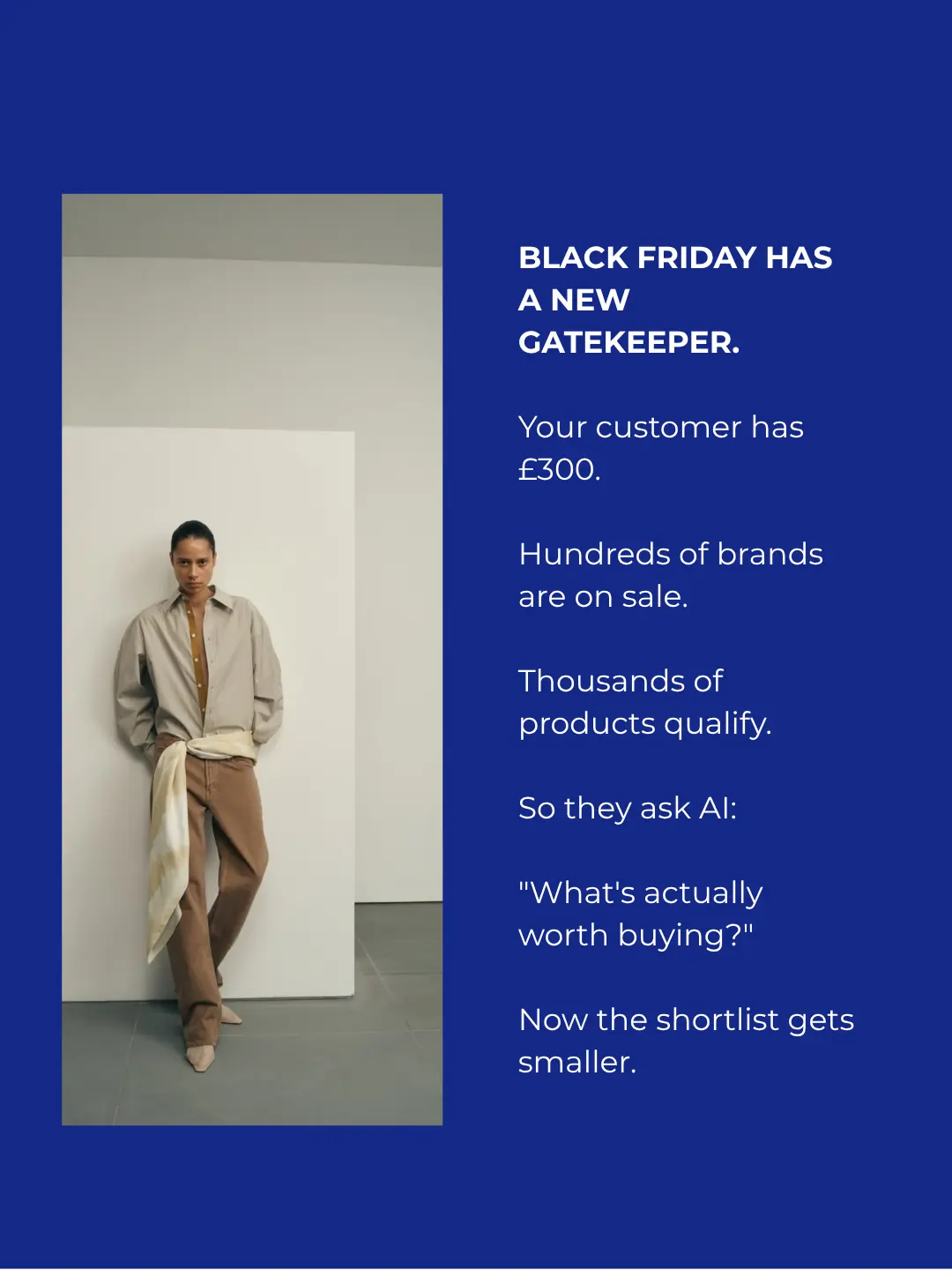
Picture a shopper in mid November. She has about £300 set aside, a winter coat that’s finally given up, and an inbox with forty “up to 50% off” emails she hasn’t opened. Every brand she’s ever heard of is running a sale. So are a few hundred she hasn’t.
She isn’t going to open forty tabs. She opens one chat window and types: “I need a winter coat that will last for years. Budget £300. What’s actually worth buying this Black Friday?”
That one sentence is the new front door to your sale, and your banner isn’t in it.
Too many discounts, not enough trust
Black Friday has a volume problem. When everything is marked down, a discount stops being a signal. Shoppers know this, which is why “worth buying” has become the real question. They aren’t asking what’s cheapest. They’re asking who to believe.
An AI assistant is very good at that kind of question, because it can weigh a lot at once. Price against budget. Fabric against how long the thing should last. Fit against reviews. A brand’s reputation against the sale price. Then it hands back a short list, usually three to five names, and explains why each one made it.
Notice what happens to everyone else. They don’t rank sixth. They just aren’t in the answer.
“Worth it” is a pile of small facts
Here’s the part we keep explaining to clients: a model can’t decide that your coat is worth £280 from a headline and a price. It needs the small facts that add up to a judgment.
What’s it made of, and how much of it? Is it lined? Does it hold up after a few winters, or is it a one season piece? Who’s it for, someone commuting in the rain or someone who wants a statement layer? Is the discount real, or is that the price it’s always been?
A shopper reading your page can pick some of that up from photos and a gut feeling. An assistant is working from text and structured data. If the details aren’t written down in a way it can read, the product reads as “a coat, £280, 30% off.” Hundreds of coats look like that.
What we see when catalogs get tested
We have a small but telling example. When we ran a contemporary ready-to-wear label through our Visibility Lab, its products were recommended in 4 of 28 realistic shopping questions. After we enriched the product data, the same 28 questions got them recommended in 8. Same questions, same model. Only the catalog changed.
Nothing was broken on those product pages. The catalog just didn’t answer enough of the questions a real shopper asks, so the assistant had little to point to when someone wanted to know what was worth the money.
That’s fixable, and it’s a lot cheaper than another round of paid traffic.
Before your sale goes live
If you’ve got a few weeks, here’s where we’d spend them:
- Pick your hero products for the sale and ask an assistant the exact question a shopper would. Budget included. See whether you show up.
- Write down what makes each one worth the money. Fabric, construction, how long it should last, what it replaces. Plain language beats clever copy.
- Check your price context. If the discount only lives in a banner image, a crawler can’t read it.
- Be honest about who it’s not for. Sizing notes and “runs small” language build trust with a model the same way they do with a person.
- Look at your crawler access too. None of this matters if the assistant can’t get in.
None of it requires rebuilding your store. It’s a layer underneath what you already have.
The shortlist is getting smaller
For years, the goal in peak season was to be seen by as many people as possible. That still matters, but a growing share of shoppers now meet an assistant before they meet your site, and the assistant’s job is to cut the list down.
So the question for your team isn’t “how big is our discount.” It’s “if someone asks whether our best product is worth the money, can an AI assistant answer yes and say why?”
Not sure what yours would say? Run a free AI visibility audit and see where your catalog stands before the sale starts. Or book a demo and we’ll walk through your Q4 hero products with you.