What it actually takes for AI to recommend your handbag
A shopper asks an AI assistant for a work bag that fits a laptop, or a gift for someone who only wears black. Here's what has to be true about your product data before your bag makes the answer.
Ask ChatGPT for “a work bag that actually fits a 13 inch laptop” or “a gift for my sister, she only wears black, budget around $200.” Watch what comes back. It doesn’t hand you a results page and let you scroll. It picks two or three bags and tells you why they fit the ask.
That “why” is the part most accessories brands haven’t thought about yet. Everyone’s focused on getting the product mentioned. Fewer brands have asked what has to be true about their listing before an AI assistant can even make that case.
The bag isn’t what AI is reading
A shopper looking at your product photo sees leather, stitching, proportions, whether it would go with what’s in her closet. She fills in a hundred small judgments without thinking about it.
An AI assistant doesn’t get that free pass. It’s working mostly from what’s written down: the title, the description, the attributes in your feed. If “vegan leather” isn’t specified as PU or a named alternative material, it doesn’t know. If the strap drop isn’t listed in inches, it can’t tell a shopper whether it’ll fit over a winter coat. It’s not being lazy. It genuinely doesn’t have the information a human eye supplies automatically.
This is why two bags that look nearly identical on a shelf can perform completely differently in AI search. The better one isn’t better made. It’s better described.
Three things have to be true
When we audit an accessories catalog, we’re really checking three separate things, and all three have to hold for a product to show up in a recommendation.
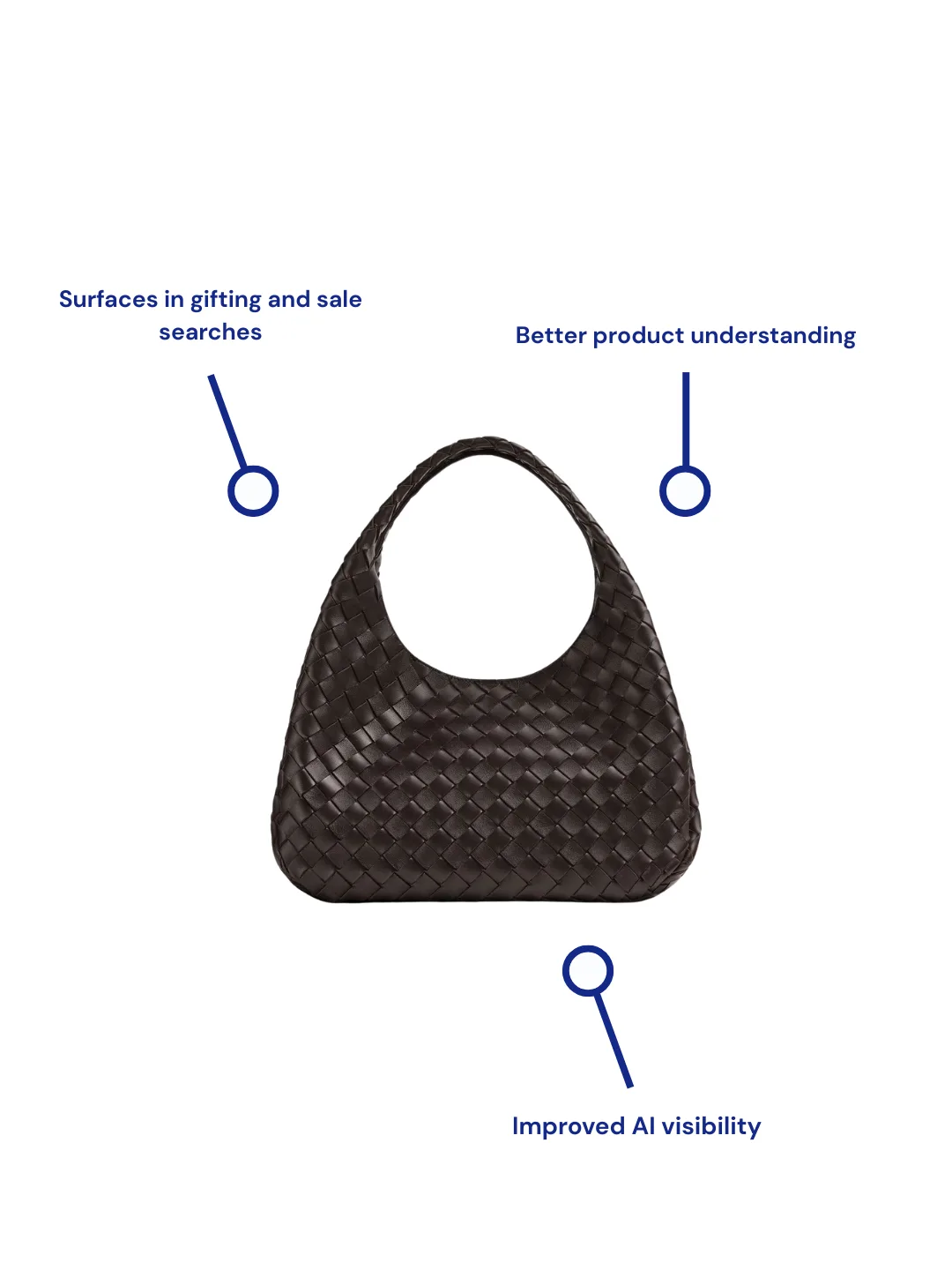
It has to surface for the occasion. A shopper rarely searches “leather hobo bag.” She searches “bag for a wedding guest” or “carry-on friendly tote” or “gift under $150.” If your product data doesn’t connect the bag to those use cases, the size and color searches, sale eligibility, gifting occasion, it never enters the running, no matter how good the bag is.
AI has to actually understand the product. Construction, materials, dimensions, what’s inside the compartments, how it’s meant to be worn. This has to exist as structured, extractable detail, not just as a paragraph of brand voice copy. “Effortlessly chic” tells a person something. It tells an AI model nothing it can act on.
Only then does visibility follow. Showing up isn’t a separate lever you pull. It’s the output of the first two being true. Brands that chase “AI SEO” without fixing the underlying data are optimizing a result they haven’t earned yet.
Where accessories brands actually lose the recommendation
In the audits we run on handbag and accessories catalogs specifically, the same few gaps show up over and over:
- Strap drop, bag dimensions, and interior compartments described in a size chart image instead of as text a model can read
- Material composition given in marketing language (“buttery soft,” “vegan leather”) instead of the actual material and finish
- No occasion or gifting tags at all, so a bag that’s perfect for a specific ask never gets connected to it
- Color and hardware variants that exist in the catalog but aren’t distinguished clearly enough for an assistant to recommend the right one
None of these are visible to a shopper browsing the site normally. A person looks at the photo and just knows the bag has a zip pocket. An AI assistant reading your feed has to be told.
Fixing this doesn’t touch your site
The good news, and it’s the same thing we tell every brand: none of this requires changing how your product pages look, your photography, or your brand voice. It’s about enriching the data underneath — the foundation of AI product discovery for ecommerce — so both AI search and AI shopping assistants can actually read what’s already true about the product.
If you want to see exactly where your accessories catalog would fail an AI assistant trying to answer “gift for someone who only wears black,” an AI visibility audit checks that in about five minutes. Or book a demo and we’ll walk through your specific catalog together.