Fifty degrees at drop-off, eighty by lunch. Does your product data know what that means?
September's real question isn't sweater or no sweater. It's the one piece that survives a fifty-degree morning and an eighty-degree afternoon, and whether an AI assistant can find it in your catalog.
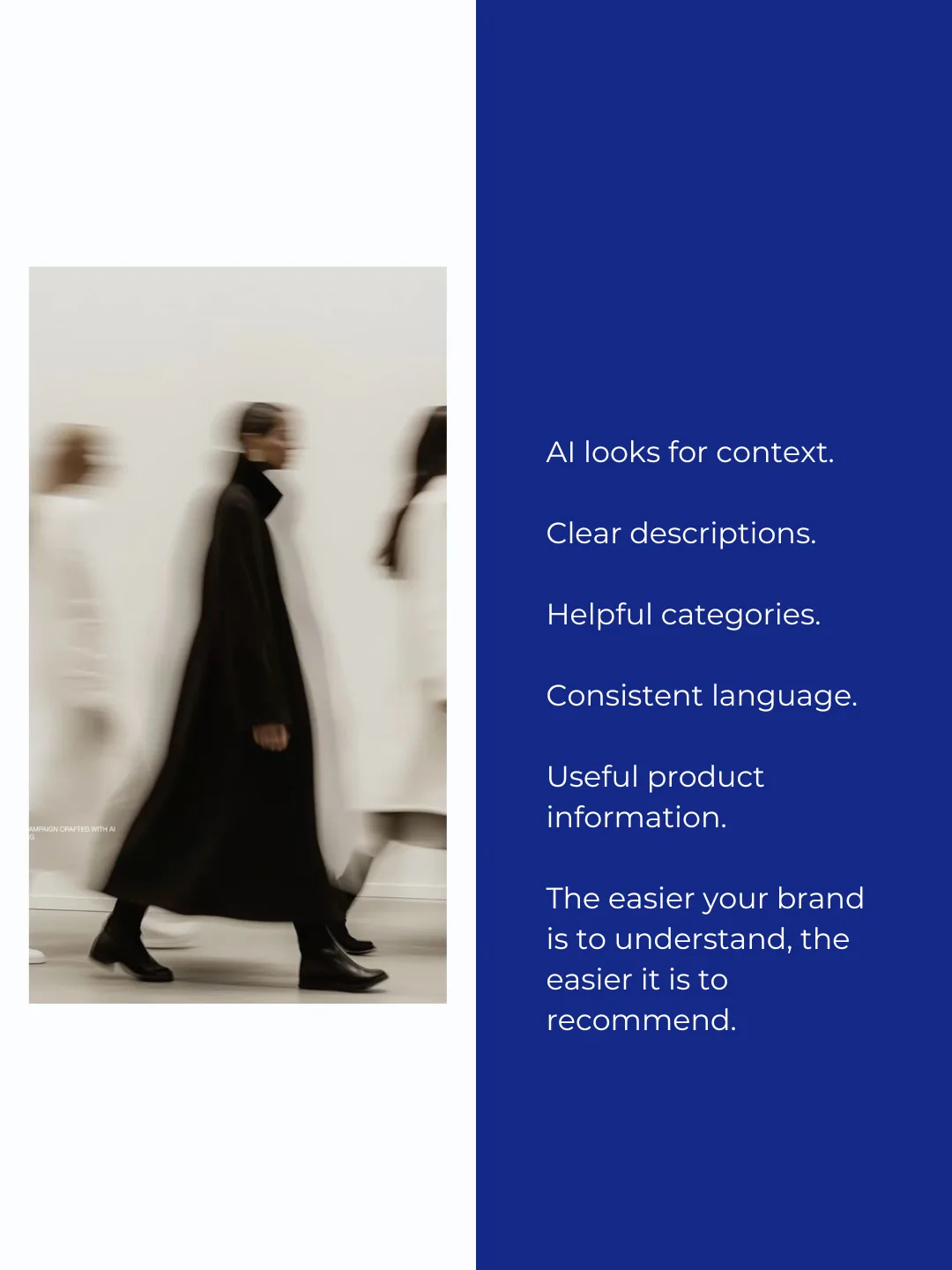
This week, somewhere, a shopper stood in front of her closet at 6:45am, checked the weather app, and saw fifty degrees now and eighty by early afternoon. She’s not going to search for a “fall jacket.” She’s going to open ChatGPT and ask something closer to “what can I wear that won’t leave me sweating on the walk home but doesn’t freeze me at the bus stop.” That’s the actual question. Most product catalogs still don’t have an answer.
The swing week nobody merchandises for
Every brand plans for summer and plans for fall. Almost none of them plan for the two or three weeks in between, when the calendar says autumn but the thermometer hasn’t gotten the memo. It’s an awkward stretch to merchandise around, so most sites either hold onto tank tops a little too long or jump straight to wool coats that make no sense at 2pm. Neither one is wrong exactly. Both just miss what’s actually happening outside.
An AI assistant fielding a question about this moment isn’t thinking in terms of “outerwear” or “knitwear.” It’s trying to reason about temperature range, how a fabric behaves layered versus alone, whether something can come off and fold into a bag without looking wrinkled three hours later. If your product page says “cardigan, size M, camel,” none of that is answerable. The model has a category and a color. It doesn’t have a swing-weather solution, so it recommends whoever wrote one.
Why this exact week is worth the extra attention
We keep coming back to this same point every time the calendar turns, because it keeps being true: the AI query cycle doesn’t match the retail calendar. Retail thinks in seasons. Shoppers, this week, are thinking in degrees. “Something I can wear over a t-shirt in the morning and tie around my waist by noon.” “A jacket that doesn’t look like I’m still in summer or already in winter.” “One layer that works for a 55 degree walk and a warm office.” None of those are trend questions. They’re weather questions, and weather questions are exactly the kind of thing most catalogs have never been asked to answer in writing.
The brands that show up in those answers usually aren’t the ones with the biggest fall drop. They’re the ones whose product data already says what the piece actually does in a temperature swing, instead of just naming the category it sits in.
What the data actually needs to say
Getting picked for a query like this isn’t a copywriting problem, it’s a specificity problem. A few things worth checking on your own product pages right now:
- Temperature range, stated plainly. “Layers well from the 50s through the 70s” tells a model something a fabric-content list never will
- Packability. Can it fold into a bag or tie around a waist without ending up creased, and does anything on the page say so
- What it pairs under or over. A model trying to solve a layering question needs to know if a piece works alone or only as part of a system
- Whether it reads as transitional at all, or whether it’s a true summer or true winter piece being stretched into a season it doesn’t belong in
None of this requires new photography or a different brand voice. It’s the same product, described with the specific detail that turns a category name into an actual answer to the question someone is typing this week.
The short window is the point
In three or four weeks this exact question disappears and a different one takes its place. That’s not a reason to skip it, it’s the reason to move now. Swing-weather searches are dense and short-lived, which means the brands that have their data ready get a real, if brief, advantage over the ones still deciding whether it’s a “fall collection” yet. A smaller catalog with three honestly described transitional pieces will out-recommend a much bigger one where everything is still labeled by season instead of by what it actually does on a fifty-to-eighty degree day.
Check what your catalog says back
Ask an AI assistant the exact question a shopper is asking this week, one with an actual temperature range attached, not just a season name. See whether your best transitional pieces show up, and whether they’re described specifically enough to be the answer instead of a guess. An AI visibility audit shows you exactly where that gap sits in your catalog, in about five minutes.
Book a demo and we’ll pull up your own products against the questions shoppers are asking this exact week.