Is ChatGPT even allowed into your store?
Brands spend weeks tightening up product copy for AI search and never check the layer underneath: whether AI crawlers can actually reach the site at all. Here's what that layer looks like, and why it has to come first.
A line in one of our Shopify App Store reviews has stuck with us longer than the star rating did. It’s from Knockout Style, a fashion retailer, and it isn’t about product copy or styling at all.
“The app doesn’t just handle product listings and styling, it’s built with AI and LLM crawler technology in mind.”
Crawler is doing a lot of quiet work in that sentence. It points at something most fashion brands skip entirely when they start thinking about AI search.
The question nobody asks first
Every brand we talk to wants to know how to get recommended in ChatGPT, or whether their product descriptions are good enough, or how their copy stacks up against a competitor’s. Those are reasonable questions. They also assume something that isn’t always true: that an AI crawler can actually reach the page in the first place.
A surprising number of stores unintentionally shut out the exact bots they’re trying to court. A robots.txt file copied over from a template two platform migrations ago. A bot-protection rule that treats anything that doesn’t look like a normal browser as suspicious and quietly drops the request. A storefront that renders product details client side, so a crawler that doesn’t execute JavaScript sees an empty shell where the product should be.
None of that shows up when you check your own site in a browser. It only shows up when you check it the way GPTBot, PerplexityBot, or Google-Extended check it.
What “built for crawlers” actually means
This part of AI search optimization has nothing to do with how well-written your product copy is. It’s infrastructure, and it’s mostly invisible once it’s done right.
It means your robots.txt explicitly allows the AI crawlers you want reaching you, rather than leaving them off an allow list that was written for search engines years ago. It means publishing an llms.txt file, a plain structured summary of your site and catalog that an AI assistant can read directly instead of guessing at your products from rendered HTML. It means your product data is available server side or in a structured feed, not locked behind a script a crawler has to execute to see anything. And it means the redirects and canonical URLs are set up so a crawler that reaches a product through one path doesn’t hit a dead end or a duplicate.
None of it touches what a shopper sees when they land on your site. It’s the layer underneath, the part that decides whether an AI assistant can even get to the product data you’ve already spent time writing well.
Why this has to come before the content work
We’ve written before about enriching product attributes so a model can match a jewelry piece to “something that feels meaningful” or a linen shirt to “what to wear in Italy in June.” That work matters, but only if the crawler reading your catalog can reach it in the first place.
It’s a bit like writing a detailed, thoughtful spec sheet and then locking it in a drawer with the visitor’s name crossed off the list. The quality of what’s inside doesn’t matter if the door never opens.
We see this most with brands that have invested seriously in content and SEO for years. Their copy is strong, their metadata is clean, and they still don’t show up in AI answers, because somewhere in the stack, a security rule or a JavaScript framework is quietly turning away the crawlers that would otherwise read all of it.
What we do differently
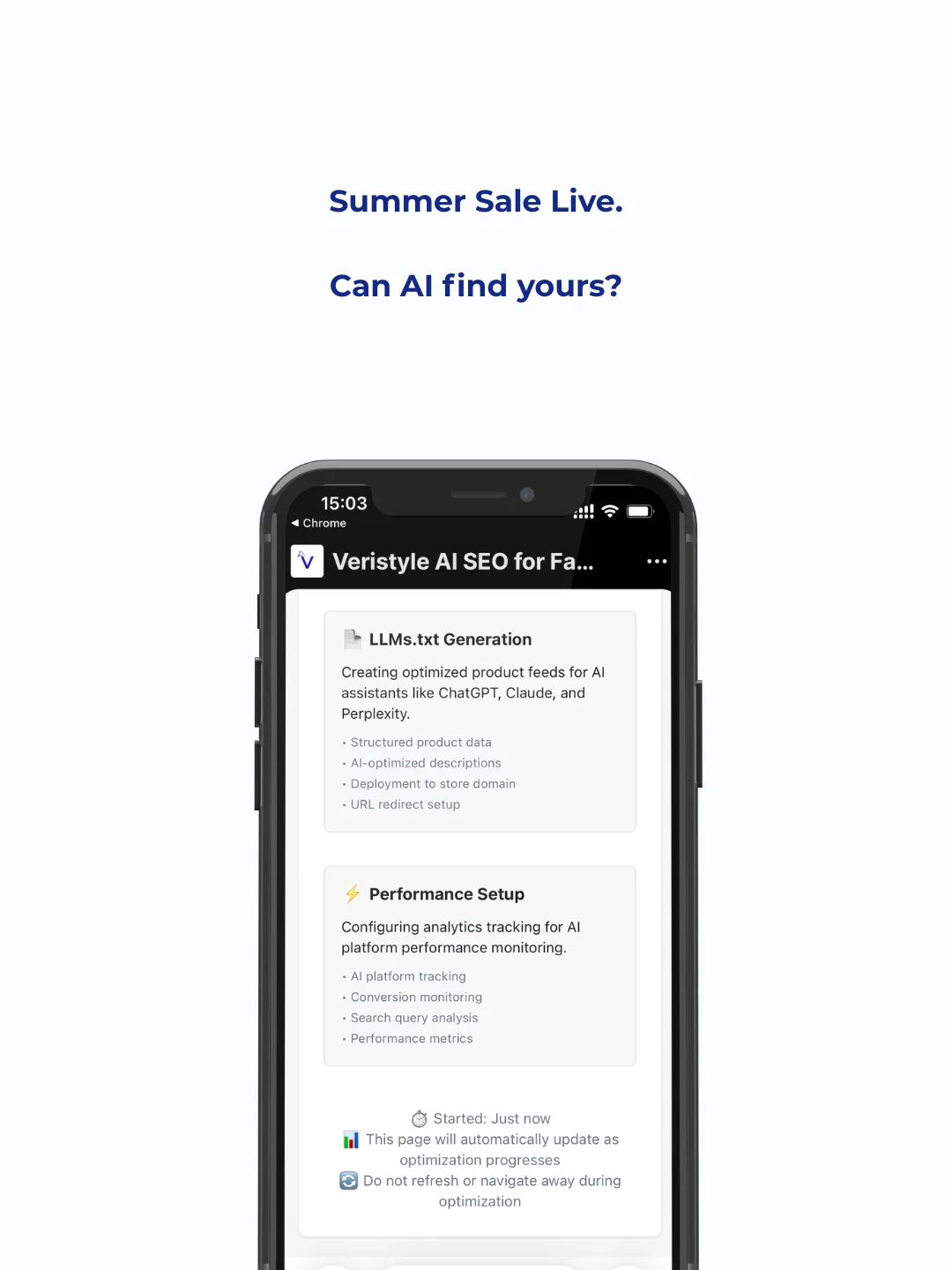
Part of why Knockout’s comment landed the way it did is that this is exactly the layer Veristyle is built to handle without anyone on a merchant’s team needing to become a crawler-access expert. We generate and deploy the llms.txt file, check that the right crawlers can actually get in, and structure the product feed so the content and attribute work underneath it reaches an AI assistant instead of stopping at the front door.
It isn’t the flashy part of AI search. Nobody screenshots a robots.txt file for their Instagram grid. But it’s the part that decides whether everything else you do for AI visibility gets read at all.
Check your own store
If you want to see whether AI crawlers can actually reach your product pages right now, an AI visibility audit checks exactly that in about five minutes, alongside the content and attribute gaps we usually talk about. Or book a demo and we’ll walk through what’s currently blocking, or letting in, AI crawlers on your store.