An agent can't buy a product. It can only buy a variant.
Recommendations talk about products. Carts hold variants. Before an AI agent can check out, something has to pick the shade, the size, the width. That choice is about the shopper, and it's the row in your catalog with the least data on it.
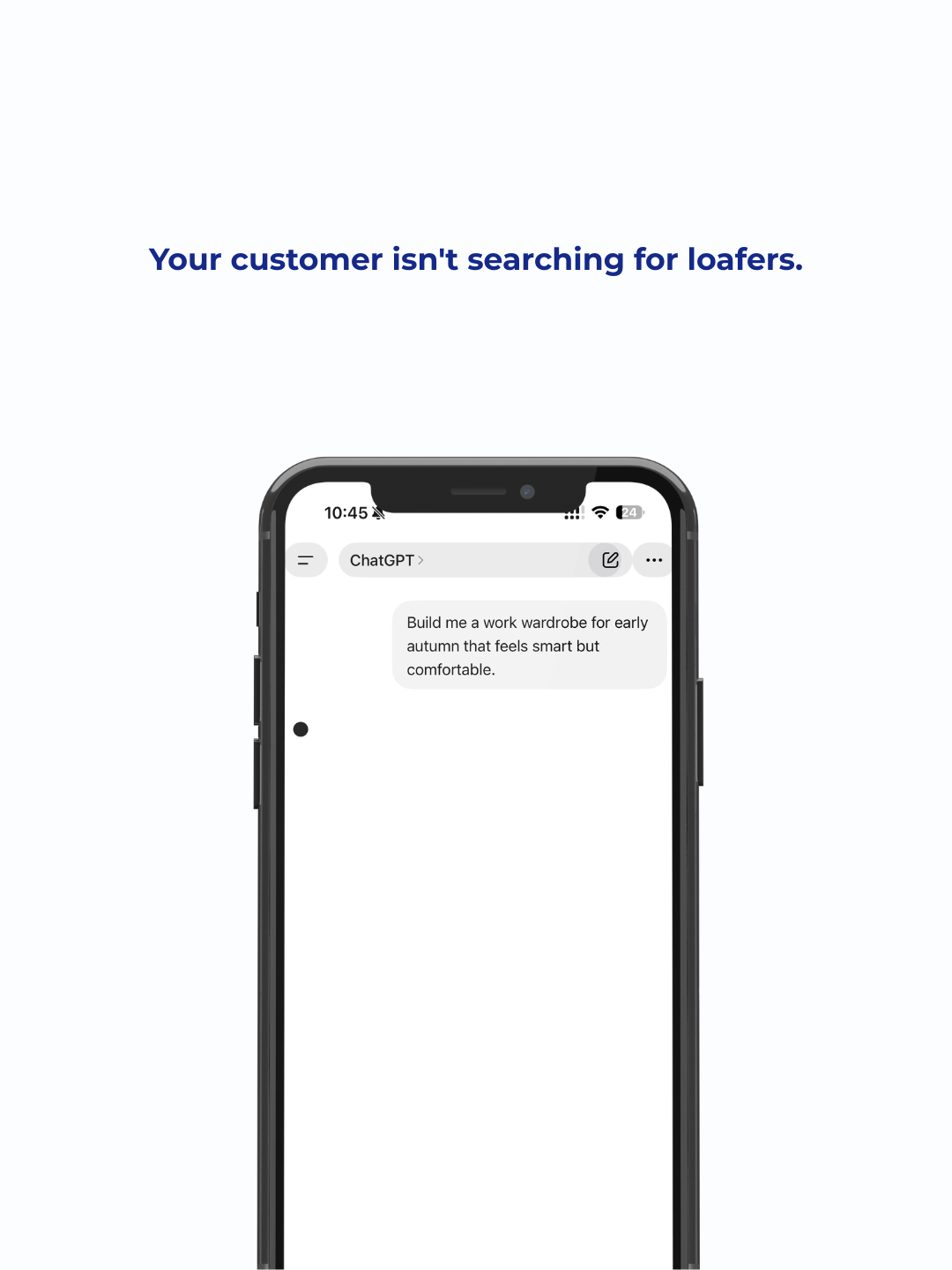
She asks her assistant for a work wardrobe that feels smart but comfortable. Somewhere in the answer is a pair of loafers. Say they’re yours.
Good. Now which ones?
Black, burgundy, or tan. Fourteen sizes. Two widths. On your store that’s one product page. In your catalog it’s 84 separate things, and only one of them is right for her.
Most of the AI visibility conversation stops at “the product got recommended.” I think that’s one step too early. A cart doesn’t hold products. It holds variants. Until something picks the 8.5 wide in burgundy, nothing has been bought.
The last decision is the hardest one
On a website, the shopper makes this choice herself, and you’ve built a lot to help her do it. Swatches. A size chart. A shade finder. Reviews that say “go half a size up.”
When an agent is doing the shopping, it has two options at this step. It can pick the variant for her, or it can hand the question back: “You’ll want to check the size guide.”
The second one is the polite failure. She asked so she wouldn’t have to do that part. And every time the job gets handed back to her, there’s a chance she doesn’t finish it.
Look at what a variant row says
Open your product export and find the lines for one product’s variants. Here’s what’s on each one: an option value, a SKU, a price, a barcode, an inventory count. Maybe an image.
That’s it.
The description, the materials, the fit notes, the enriched attributes from whatever GEO work you’ve done, all of that sits on the product. The variant gets a label. “8.5 W.” “Burgundy.” “240N.” “Sand.”
So the richest data in the catalog is attached to something nobody can put in a cart. The thing she actually buys is a label and a barcode.
Variant labels are a private language
And the labels don’t travel.
“Sand” is a light neutral at one brand and a medium warm at another. A size 8 means something different in nearly every store she’s shopped. “240N” makes sense to your product team and to the customers who already wear it.
An agent reading that label can’t tell what “Sand” looks like on olive skin, or whether your 8.5 fits like the 8.5 she already owns.
This is where the product half and the person half of the query split cleanly. Whether these are good loafers for an office is a product question, and it’s the same answer for everyone. Which pair fits her foot is a person question, with a different answer for every shopper.
Shade is about her skin depth and undertone. Size is about her body. Width is about her foot. Inseam is about her height.
The variant is where the matching gets settled, and it’s the row with the least on it.
Wrong variant, right product
An agent that has to choose and has no evidence will guess. The middle shade. Her usual size. Sometimes that works out.
When it doesn’t, the order comes back, and the return gets logged against the product. But the product was right. The agent just couldn’t get from the product to the one version that fit.
Ask your returns team how much of what comes back is “wrong size” or “wrong shade.” That pile is variant selection failing, one order at a time. Today a person makes that choice with a size chart in front of her. Soon an agent makes it with a label.
What a variant needs to carry
Not more copy. The same kind of structured facts the product has, one level down.
For a shade: depth and undertone in plain shared words, not just the brand’s name for it. What the color looks like on skin, read from the swatch and the on-model photos.
For a size: the measurements, and how this product runs against them. Who it fits. Who should go up.
For a color: what it is, in words a model already knows. “Deep red-brown, cool leaning” tells an agent something. “Merlot” doesn’t.
This is the level we build to at Veristyle. Computer vision reads product images for more than 200 style, fit, and color traits, and it reads the image, not the name someone gave the color. The model of the customer sits on the other side: skin tone and undertone, body shape, style, occasion, intent, geography. A match isn’t finished at “this product suits her.” It’s finished at the shade or the size.
Other GEO work gets the product read and listed. That’s indexed. Once the agent is the one checking out, chosen means a specific variant in a cart.
A ten minute test
- Pick the best seller with the most variants. A foundation, a jean, a shoe.
- Ask an assistant as a specific person. “I have medium skin with an olive undertone, and most shades go pink on me. Which shade of this should I get?” Or: “I’m 5’4”, between a 6 and an 8, and I have wide feet."
- See whether it names a variant. A real shade or size, with a reason. Or does it send you to the shade finder?
- If it names one, check it. Would your own team have picked the same one for her?
If the answer is “check the size guide,” the agent found your product and stopped one step short of the sale.
See how far agents get with your catalog
A free AI visibility audit shows how assistants describe your products today and where they run out of information. To see the match run down to shade and size on your own catalog, book a demo.