Before it recommends anything, the agent asks her three questions. Can your catalog use the answers?
Ask a shopping assistant for a trench coat and it asks about you before it shows a single product. Those questions are the closest thing a brand will get to a spec for what its catalog needs to hold. Here is how to read them, and what happens to an answer that has no field to land on.
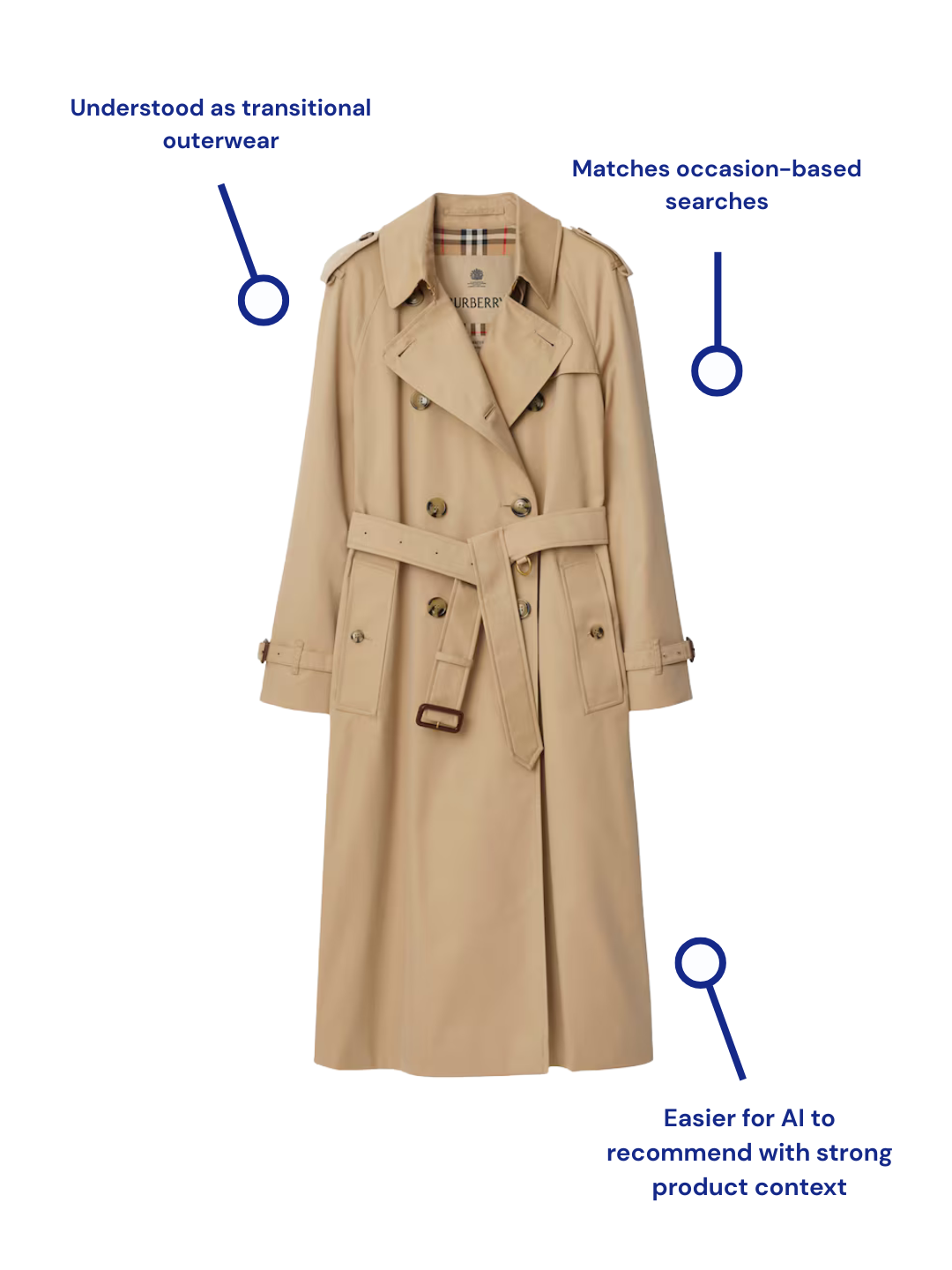
Type “I need a trench coat” into ChatGPT’s shopping research mode and you won’t get a trench coat. You get questions.
Before a single product shows up, it wants to know things like your budget, how tall you are, what the weather is like where you live, and what you’ll mostly be wearing it over.
One of those four is about the product. The other three are about you.
I think those questions are the most useful thing a brand can read right now. Almost nobody is reading them.
The questions are the spec
These aren’t a fixed script. The wording changes from one run to the next. The assistant asks because it has worked out which unknowns stand between a vague request and a pick it can defend. It is showing you its matching step, in order, before it runs it.
That makes the questions a list of the attributes that decide your category. And look at which half of the query they fall on.
For a coat: height, climate, what goes underneath. For a foundation: skin type, undertone, how much coverage she is comfortable in, whether her current shade goes orange or gray on her. For jeans: where her current pair gaps or pulls, her inseam, how much stretch she will put up with.
It almost never asks what fabric weight she wants or what kind of closure. It can read those off the product. What it can’t read off the product is her, so that is where it spends its questions.
An answer needs somewhere to land
Say she answers: 5’4", Seattle, over a blazer most days.
Now the assistant takes those three facts to the catalog. Here is what it finds for a typical trench.
“Classic trench coat. Beige. 100% cotton. Belted. Sizes XS to XL. $395.”
5’4". It needs the length in inches, or where the hem falls on someone her height. Mid calf on the model could be ankle on her. The listing has a size run.
Seattle. It needs to know whether the cotton is treated for rain or will soak through in ten minutes. The listing says cotton.
Over a blazer. It needs the cut through the shoulder and upper arm. Raglan or set in, how much room. The listing says “relaxed fit,” which could mean anything.
Three answers, three misses. She did her part. The information died at the catalog.
What happens next is predictable. The assistant either guesses from reviews, or it leans toward the coat whose listing can actually use what she said. If a competitor’s trench says “44 inches long, hits below the knee at 5’4”, water repellent finish, raglan sleeve cut to layer over tailoring," that coat gets a recommendation with three reasons attached. Yours gets “a classic option.”
This is indexed vs. chosen in one exchange. Both coats were found. Only one could answer.
Soon it won’t ask out loud
Here is the part that makes this urgent. The questions are visible today because the assistant doesn’t know her yet.
That is changing quickly. ChatGPT carries details over from earlier conversations. Once she has told it her height and her city, it stops asking. An agent shopping on her behalf won’t ask at all. It already holds the answers, and it goes straight to checking them against product data.
The matching step doesn’t go away. It goes quiet. The same three facts get tested against your listing, and you never see the test. For now the assistant is still saying its reasoning out loud, and it costs nothing to listen.
What the catalog has to hold
For every question the assistant asks about the shopper, the product needs a field that can take the answer. Not a tag that says “petite friendly.” A fact the answer can be checked against.
This is the work we do at Veristyle. Computer vision reads the product itself and pulls more than 200 style, fit, and color traits, including the ones that never make it into a feed: where the hem actually falls, how the shoulder is cut, how a shade leans. A model of the customer supplies the other side: physical traits, skin tone and undertone, body shape, style, occasion, intent, geography. Then the two get matched, and the result is written back in a form a model can read.
Most GEO work makes the product half of the query easier to read. That gets you indexed. The assistant’s questions are all about the person half, and that is the half that gets you chosen.
Run this on your own category
- Ask vaguely. Open ChatGPT’s shopping research, or any assistant that asks follow-ups, and request your hero product’s category with no detail. “I need a trench coat.” “I need a new foundation.”
- Write down every question it asks back. Mark each one as product or person.
- Answer as a real customer would. Pick someone specific. Your most common return reason is a good place to find her.
- For each answer, find the field. Open your own listing and look for the exact fact the assistant would need to use what she said. Not copy that hints at it. The fact.
Count the answers with nowhere to land. That number is your gap, and it is a much more honest one than a mention rate.
See where your answers land
A free AI visibility audit shows how assistants describe your products today and which shopper questions they can’t answer from your catalog. If you’d like to walk through the matching on your own products, book a demo.