Why Most Fashion Product Feeds Fail in AI Search and How to Fix Them
Dec 10, 2025
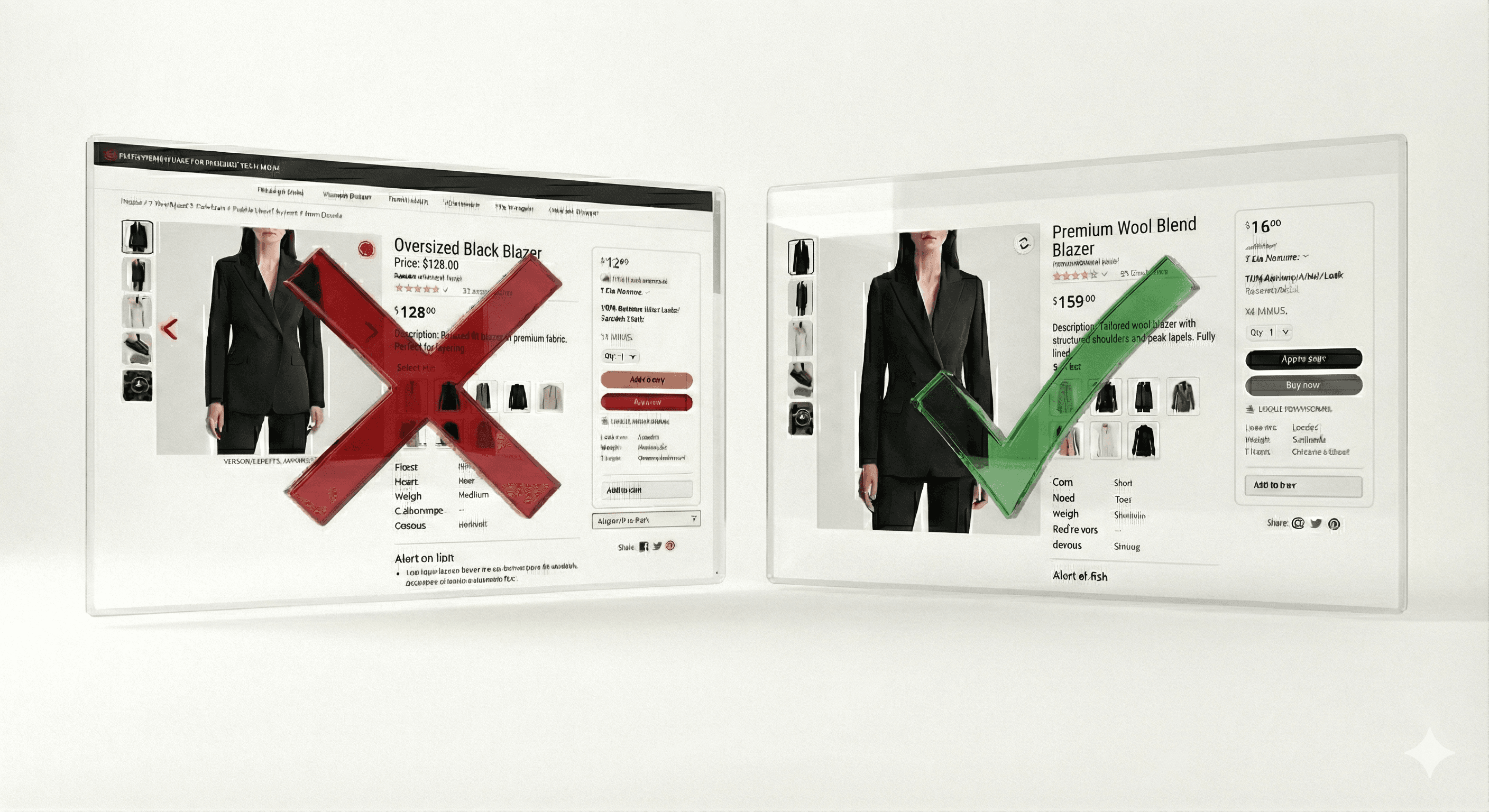
AI search is changing how customers find fashion and beauty products, but most product feeds are not prepared for this shift. Brands often assume that if their catalog works for Shopify and Google, it will work for AI models. It will not.
Fashion and beauty behave very differently from other commerce categories in AI search. Clothing, makeup, skincare, and accessories rely on visual, emotional, and physical cues that generic AI SEO tools cannot interpret. A laptop or a water bottle can be described with simple specs. A dress or a serum cannot. These categories depend on fit, undertone, texture, climate, silhouette, and how a product makes someone feel. That is where most feeds fall short.
AI search works through natural language. Shoppers describe themselves and their needs in full context.
“I am 5 foot 2 with warm undertones and I need a winter coat.”
“I want trousers that make my legs look longer.”
“I need a gentle cleanser that works in humid weather.”
The model looks for products that match the intent and the body details. Most feeds do not contain enough information for the model to make the match, so the brand stays invisible.
Why product feeds fail in AI search
1. They lack body relevant details
AI models cannot infer how something fits. They need cues like relaxed shoulder line, curve friendly hip shape, petite length, or compressive stretch.
2. They use color words that lack meaning for beauty and apparel
Color families, undertones, depth, and finish matter. AI models interpret these, but most feeds only include generic labels.
3. They ignore fabric and formula behavior
Climate, breathability, drape, texture, finish, and moisture response often influence prompts, but most feeds do not include this information.
4. They rely on SEO style descriptions
Keyword density does not help AI search. Models need clarity and natural context, not marketing copy.
5. They store the right information in the wrong places
If key cues are only in imagery or loosely written text, AI cannot extract them.
Why generic AI SEO tools do not work for fashion and beauty
Most generic tools assume every product type can be optimized the same way. They focus on keyword patterns or metadata that apply well to electronics, home goods, and other structured categories. These tools are not designed to interpret fit logic, drape, undertone, silhouette, texture, or climate behavior. As a result, the catalog might be optimized for Google, but it remains unreadable to an LLM trying to answer a personal styling question.
Fashion and beauty require interpretive context that explains both who the product is for and how it performs. Without that context, AI simply cannot connect the product to the customer’s natural language request.
How brands can fix this
1. Use natural shopping language
Describe fit, feel, shape, finish, and use cases the way a stylist or beauty advisor would describe them to a person.
2. Add structured signals for body relevance, color accuracy, undertone, material, and intent
Specific cues help the model understand what the product actually does.
3. Treat product context as part of your growth engine
Your feed is now the first impression you make in AI driven conversations.
4. Optimize for how people search today
Shoppers tell AI who they are. Your products should be able to meet that level of detail.
A note on how we approach this at Veristyle
At Veristyle, we focus on adding the interpretive context that fashion and beauty products require for AI search. This happens in the background and does not change what customers see on the site. The PDP stays the same. The brand voice stays the same. What changes is how AI systems understand the catalog.
The goal is simple. Give AI enough clarity about fit, color, fabric behavior, undertone, silhouette, and intent so it can accurately match your products to the natural language prompts shoppers use today.
AI search will reward brands that provide this level of context. Most catalogs are not there yet, which is exactly why early adopters will see the biggest lift in visibility.