Universal Commerce Protocol (UCP): How Fashion & Beauty Brands Can Win in AI Answers
Feb 25, 2026
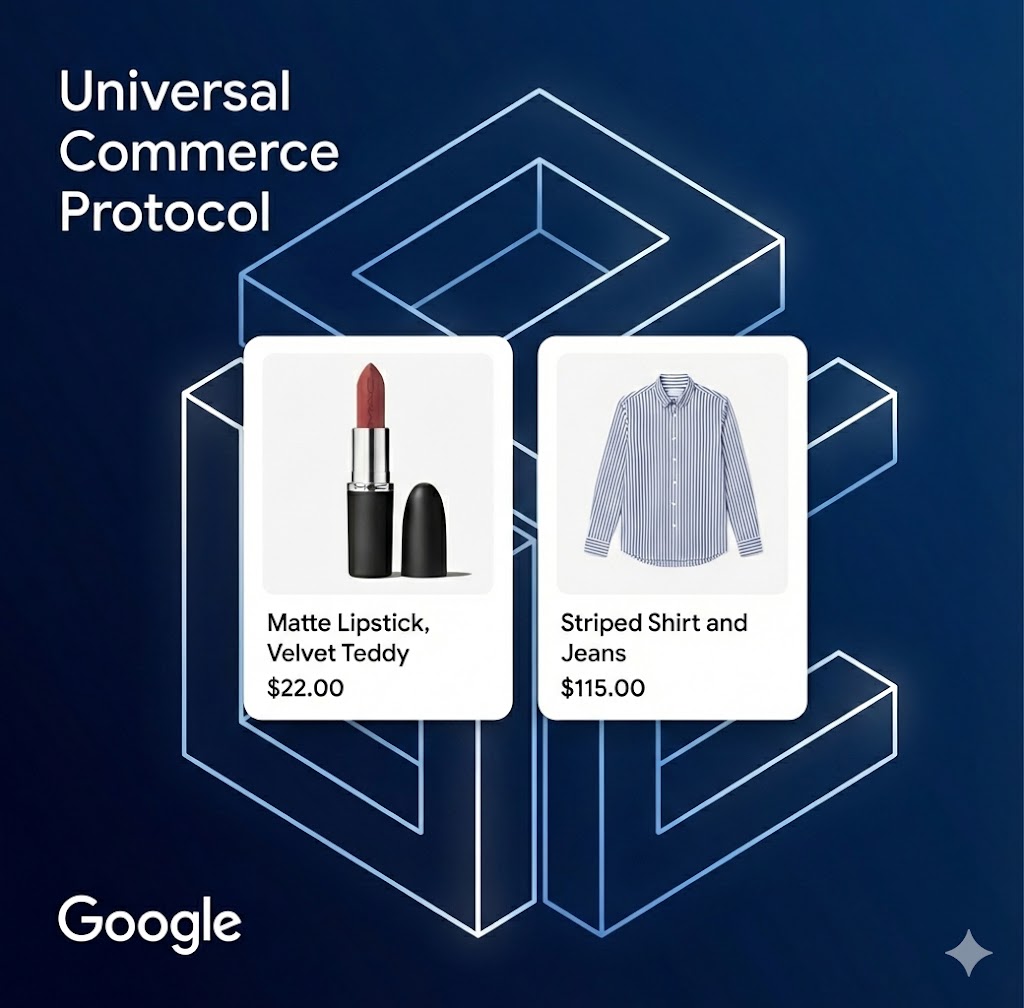
Search is changing faster than most commerce teams can replatform.
Consumers are no longer just typing keywords into Google and scrolling. They’re asking ChatGPT, Google AI, Perplexity, and shopping agents questions like:
“What’s a clean, long-wear foundation for oily skin under $60?”
“I need a black blazer that works for broad shoulders and a petite frame.”
“What’s a dupe for this lipstick but more hydrating?”
And the “winner” isn’t the brand with the biggest ad budget. It’s the brand whose products are most understandable to AI and therefore most selectable when an agent composes an answer.
That’s exactly where UCP (Universal Commerce Protocol) comes in.
What is UCP (in plain English)?
UCP is a new approach to commerce infrastructure designed for the AI era: a standardized way for brands and retailers to make product information, availability, pricing, and purchase actions easier for AI systems and partner platforms to understand and use.
Think of it as: “Let’s make commerce machine-readable end-to-end.”
Not just “here’s a product page,” but “here’s the structured truth about what this product is, who it’s for, what it does, what it’s comparable to, and how to buy it.”
If SEO was about being crawlable for web search, UCP-era commerce is about being legible for AI answers and agentic shopping.
The uncomfortable truth: AI can’t recommend what it can’t understand
Most fashion and beauty catalogs are still optimized for humans skimming PDPs, not models reasoning across products.
Common problems we see:
Beauty data gap
Shade and undertone are inconsistent (or missing)
Finish, wear time, sensitivity triggers, and ingredients aren’t normalized
“Clean,” “non-comedogenic,” “fragrance-free” are marketing labels without proof mapping
Claims aren’t grounded in structured attributes
Fashion data gaps
Fit terms are vague (“relaxed,” “regular,” “tailored”) without measurements
No structured data for stretch, drape, transparency, weight, seasonality
Styling intent isn’t captured (work, wedding guest, travel, capsule, etc.)
Images exist, but attributes derived from images aren’t captured as data
AI answers depend on matching constraints. If the system can’t reliably map “oily skin + humidity + long wear + non-cakey + medium coverage” to a product’s attributes, it will recommend competitors that do map cleanly — or it will default to the brands it has seen described more consistently across the web.
Where UCP changes the game for brands
UCP is essentially a forcing function: brands need to provide clean, consistent, structured commerce data so that AI systems can:
Understand what a product is
Compare it to alternatives
Select it for a specific user intent
Route the user to purchase with minimal friction
But here’s the key:
UCP alone doesn’t make you stand out.
It makes you compatible.
To win, you need to go beyond compatibility into product intelligence.
The new ranking factor: “Answer-worthiness”
In the AI era, brands compete on answer-worthiness — how easily an AI can justify choosing your product for a specific prompt.
That means your product data needs:
High coverage (few missing fields)
High precision (not generic marketing)
High consistency (normalized terminology across the catalog)
High semantic richness (synonyms, use-cases, outcomes, comparisons)
This is what product enrichment is really about.
Not “more tags.”
Better meaning.
What “product enrichment” should mean in 2026
For fashion & beauty, enrichment isn’t just adding a few metafields. It’s building a product layer that AI can reason over.
Beauty enrichment that drives AI selection
Shade mapping: depth, undertone, match notes (e.g., “olive-friendly”)
Finish + wear: matte/dewy/satin; transfer resistance; humidity performance
Skin compatibility: acne-safe flags, irritation triggers, fragrance status
Ingredient-level semantics: actives, exclusions, sensitivities
Use-case truth: “under makeup,” “photography,” “all-day wear,” “sweat-resistant”
Comparable products: “closest match to X, but more hydrating”
Fashion enrichment that drives AI selection
Fit & measurements: structured fit, rise, inseam, stretch %, shoulder width
Fabric behavior: drape, weight, thickness, breathability, pilling tendency
Styling intent: workwear, travel, capsule, wedding guest, resort, modest
Body-aware fit guidance: what works for curves, petite proportions, broad shoulders
Visual attributes from images: neckline, silhouette, sleeve type, pattern scale
Outfit compatibility: “pairs with” and “layering logic”
Most brands have some of this in copy. AI needs it as data.
How Veristyle helps brands stand out in AI answers
Veristyle is built for exactly this moment: when commerce becomes agentic and brands need a shared intelligence layer that powers both AI visibility and on-site discovery.
Here’s how it works in practice:
1) Turn your catalog into AI-readable product intelligence
Veristyle enriches product data so that AI systems can reliably understand:
What the product is
Who it’s for
When it’s the best choice
How it compares
This isn’t generic tagging. It’s building a consistent attribute schema + semantic layer across your entire catalog.
2) Increase your “AI answer share” with Generative Engine Optimization (GEO)
Traditional SEO is about ranking web pages.
GEO is about becoming the brand AI references and selects in answers.
Veristyle helps brands:
Identify where AI misunderstands or ignores products (visibility audits)
Fix missing/ambiguous attributes that block selection
Generate AI-friendly product signals (without rewriting your entire site)
Align product truth across feeds, storefront, and partner channels
3) Make UCP actually work for you (not just for the platforms)
If UCP standardizes “how to transact,” Veristyle strengthens “why you get selected.”
With a richer product layer, your UCP-compatible feed becomes:
More complete
More comparable
More trustworthy for agent selection
This is how you avoid becoming interchangeable.
What your peers will do (and why it won’t be enough)
Most brands will react in one of three ways:
Do nothing and hope brand awareness carries them
Add a few metafields and call it “AI-ready”
Buy a generic enrichment tool that doesn’t understand fashion/beauty nuance
That might get you “indexed.” But it won’t get you chosen.
Because the brands winning AI answers will have:
Deeper, cleaner attribute coverage
Body/skin/hair-aware semantics
Better comparability across similar products
Better alignment between product truth and user intent
A simple playbook: How to start winning AI answers now
Step 1: Run an AI visibility audit
Pick 20 high-intent prompts customers actually ask.
See which of your products show up and why (or why not). We can do this for free at veristyle.ai
Step 2: Identify the “selection blockers”
Typical blockers:
Missing fit/shade/finish attributes
Ambiguous claims (“hydrating” without context)
No structured mapping to common intents (“humid weather,” “sensitive skin,” “petite”)
Step 3: Enrich the top revenue-driving categories first
Don’t boil the ocean.
Start with the 200–1,000 products that drive the most revenue and represent your brand.
Step 4: Publish consistent product intelligence across channels
Ensure the same enriched truth exists across:
Shopify/SFCC feeds
PDP structured data
Partner feeds
UCP-compatible formats
Step 5: Measure “answer share” like a growth metric
Track:
Inclusion rate in AI answers for key prompts
Product selection rate for category intents
Click-through to PDP
Conversion on AI-referred sessions
Reduction in returns (better fit guidance)
The takeaway
UCP is a major signal that commerce is shifting from “search and browse” to “ask and decide.”
But the brands that win won’t be the ones who simply adopt the protocol.
They’ll be the ones who build product intelligence that makes their catalog:
More understandable to AI
More trustworthy to recommend
More defensible against lookalikes
More aligned to real customer intent
That’s the gap Veristyle fills: a shared product intelligence layer that powers AI-native discovery, improves visibility in AI answers, and helps fashion & beauty brands stand out — before everyone else catches up.