Your customer isn't searching for a trench coat
A shopper doesn't type a product name into ChatGPT. She types the situation she's actually in, like what to wear back to work when it's still warm out. Most catalogs still can't answer that.
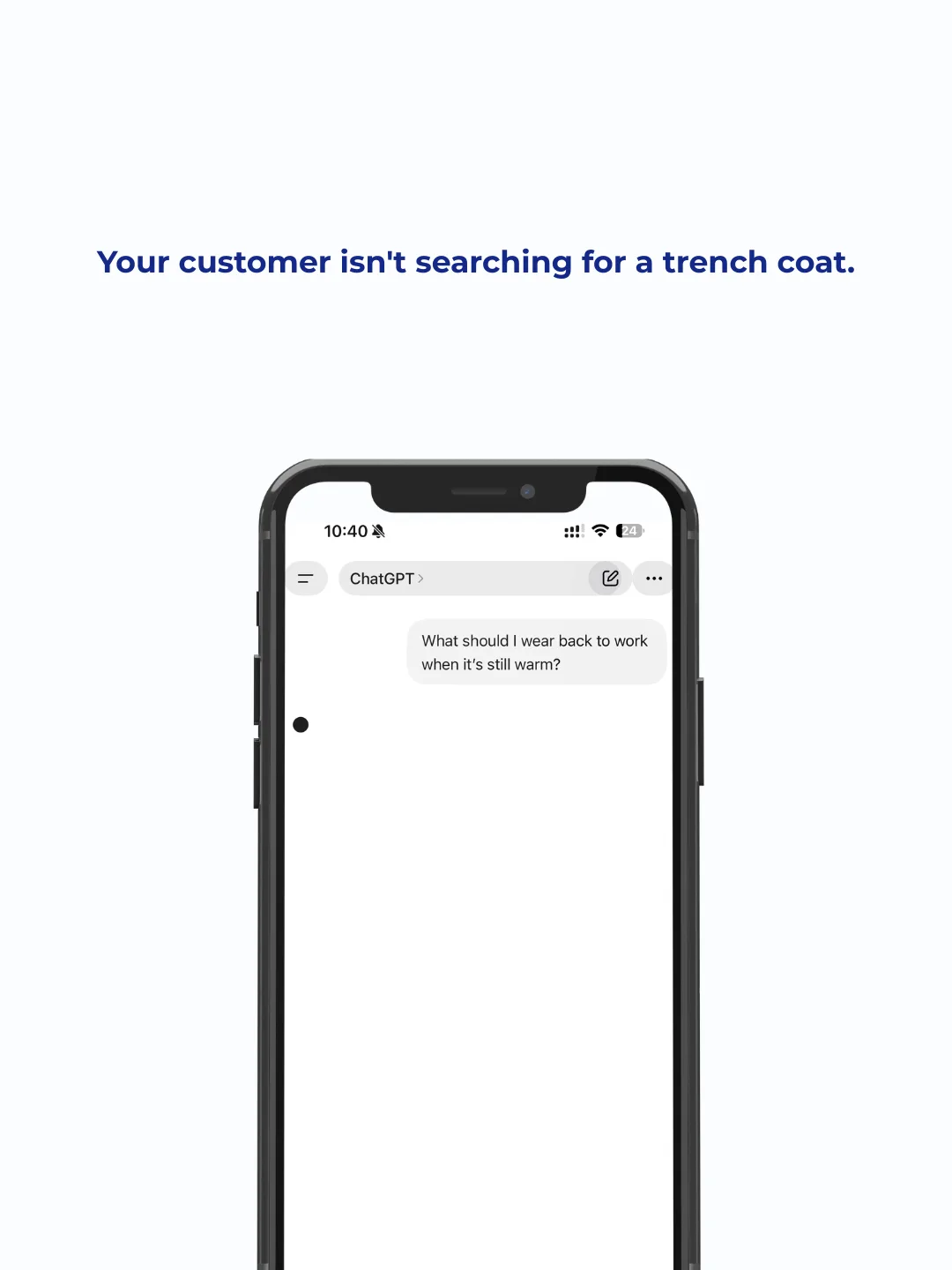
Somewhere this week, a shopper opened ChatGPT and typed something like “what should I wear back to work when it’s still warm out.” Not “lightweight blazer.” Not “transitional workwear.” Just the actual problem sitting in front of her: the office wants pants and a jacket, and it’s 84 degrees outside.
That query is the whole shift in one sentence. She’s not searching for a trench coat. She’s describing a situation and waiting for something to make sense of it. And most product catalogs, built around category names and keyword tags, have nothing useful to say back.
The gap between how catalogs are built and how people actually ask
Product data has been organized the same way for twenty years: category, subcategory, color, size. That structure works fine when a shopper already knows the noun she’s looking for. It falls apart the moment she doesn’t, and right now, in late August, almost nobody does. Nobody thinks in terms of “outerwear” when they’re standing in front of a closet trying to figure out how to look put together for a 9am meeting without sweating through a blazer by 10.
An AI assistant fielding that question isn’t scanning for the word “trench.” It’s trying to reason through fabric weight, layering logic, how a piece behaves indoors under office AC versus outdoors on a humid commute. If your product data only says “jacket, size M, navy,” the model has nothing to reason with. It moves on to whoever described the thing as breathable, unlined, layers over short sleeves, holds up in humidity.
Late August is a strange, short window, and it matters more than it looks
This particular stretch of the calendar gets skipped over constantly. It’s not summer clearance anymore and it’s not real fall weather yet. Brands tend to either hold their summer merchandising a few extra weeks or jump straight to heavy coats and boots, and neither one matches what a shopper is actually dealing with on a 85 degree Tuesday when she still has to walk into an office.
That mismatch is exactly the kind of query we keep seeing when we pull AI search data for brands this time of year. “Work outfit that transitions from AC to outside heat.” “Something professional that doesn’t feel like a winter coat yet.” “Layers I can take off at my desk.” These aren’t rare edge cases. They’re what a huge share of back-to-office shopping actually sounds like for about six weeks every year, and the brands whose data speaks to that moment are the ones showing up in the answer.
What actually needs to be true in the product data
Getting recommended for a query like this isn’t about writing more copy. It’s about whether the specific, situational stuff is captured somewhere a model can read it:
- Fabric behavior, not just fabric name. “Breathable” and “structured but not stiff” tell an AI assistant something a fiber content list doesn’t.
- Layering logic. Does this work over a sleeveless top? Does it need something underneath once the office AC kicks in?
- Occasion specificity beyond “work.” Client-facing, casual Friday, and a long commute in the heat all call for different things, even from the same jacket.
- Weather range. A piece that reads as “true fall” is a mismatch right now, no matter how nice it looks in a flat lay.
None of that requires new photography or a rewrite of your brand voice. It’s a layer of context sitting underneath the product page, the same underlying AI search optimization work that shows up across every seasonal shift, just pointed at this specific six week window.
Why the brands that nail this are rarely the biggest ones
We say some version of this in almost every post because it keeps being true: this isn’t a budget problem. A two hundred SKU catalog with specific, weather-aware descriptions will out-recommend a two thousand SKU catalog still labeled “fall jacket” in August. The model isn’t rewarding size. It’s rewarding whoever actually described the thing a real person is dealing with.
The window for this particular query is short. In three or four weeks it’ll be genuinely cool out and the question changes again. Right now, though, is exactly when “still warm but back at a desk” is being typed into an AI assistant on repeat, and it’s worth checking whether your catalog has anything to say back.
See where you stand
Ask an AI assistant the exact question a shopper would ask this week, something with a real situation attached, not just a category. See whether your brand comes up, and whether it’s described in a way that actually fits the moment. An AI visibility audit shows you exactly where that gap is, product by product, in about five minutes.
Book a demo and let’s see what your catalog looks like to the shoppers asking this question right now.